ASOL supplies finished LiFePO4 batteries for RV, camper, caravan and mobile-power projects. Available solutions include 12.8V LiFePO4 batteries in 100Ah–400Ah capacities, 25.6V LiFePO4 batteries in 100Ah and 200Ah capacities, plus 38.4V 100Ah and 51.2V 100Ah LiFePO4 batteries for compatible higher-voltage deep-cycle and lead-acid replacement systems. Integrated RV power solutions are also available with project-specific BMS, monitoring, terminal and enclosure options.
Selecting an RV lithium battery requires confirmation of the vehicle’s system voltage, required usable energy, continuous and peak load, charger and inverter specifications, installation space, terminals and operating environment.
Battery functions, communication options, series or parallel connection capability, and documentation vary by product and must be confirmed before ordering.
Core Deep-Cycle Applications
RV & Camper
House battery solutions for RVs, camper vans and caravans, including inverter loads, solar charging, alternator charging and extended off-grid use.
- Capacity and installation space
- Inverter and charging compatibility
- BMS current and system planning
Marine & Electric Propulsion
LiFePO4 battery configurations for boats, trolling motors, electric outboards and onboard DC power systems, with discharge capability, BMS, terminals and enclosure selected according to the application.
- System voltage and motor power
- Continuous and peak current
- BMS, marine terminals and enclosure / IP requirements
- Series / parallel and Bluetooth / APP monitoring if required
For trolling motors and electric outboards, battery selection should be based on motor voltage, rated power, continuous current and peak current rather than capacity alone.
Golf Cart & Utility Applications
Deep-cycle LiFePO4 battery configurations for golf carts, utility vehicles and compatible commercial vehicle electrical systems replacing traditional lead-acid, GEL or AGM batteries.
- System voltage, capacity and load
- Charger compatibility
- Installation dimensions and terminals
- Project-specific BMS configuration
Other Deep-Cycle & Lead-Acid Replacement Applications
The same LiFePO4 platforms can also be configured for other compatible deep-cycle and lead-acid replacement applications, depending on system voltage, load current, charging method and installation requirements.
Solar & Backup Power
For compatible solar storage and backup applications requiring deep-cycle battery operation and stable DC power.
Remote Monitoring & Switching Systems
For remote monitoring, switching and standby applications requiring stable DC power, low self-discharge and long cycle life.
Commercial & Mobile Equipment
For compatible mobile, commercial and specialist equipment replacing traditional lead-acid, GEL or AGM battery configurations.
Choosing the Right Battery Configuration
Battery configuration should be selected according to the actual electrical system and load rather than voltage and capacity alone.
- System voltage
- Required capacity
- Continuous load current
- Peak current
- Charger compatibility
- Available installation space
- Terminal configuration
- Enclosure / IP requirements
- Series / parallel requirements
- Monitoring / Bluetooth requirements
- OEM / branding requirements
LiFePO4 Battery Recommendations by System Voltage
Explore standalone 12V and 24V LiFePO4 batteries, compatible 36V- and 48V-class deep-cycle options, or an integrated RV power system based on your electrical architecture and project requirements.
12V Standalone RV Batteries
LiFePO4 battery options for 12V camper van, motorhome and RV electrical systems.
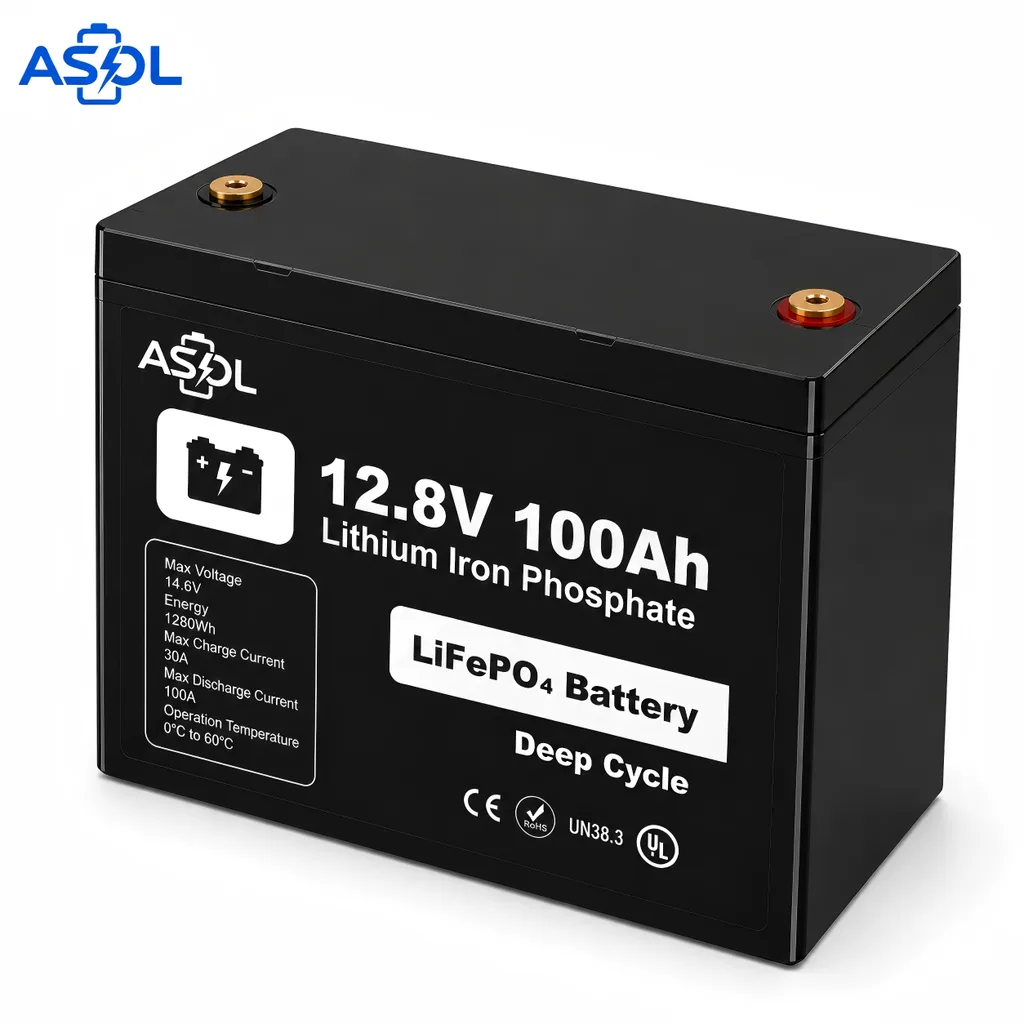
Compact LiFePO4 option for RV auxiliary and lower-capacity house-power applications.
- 12.8V
- 100Ah
- 1.28kWh
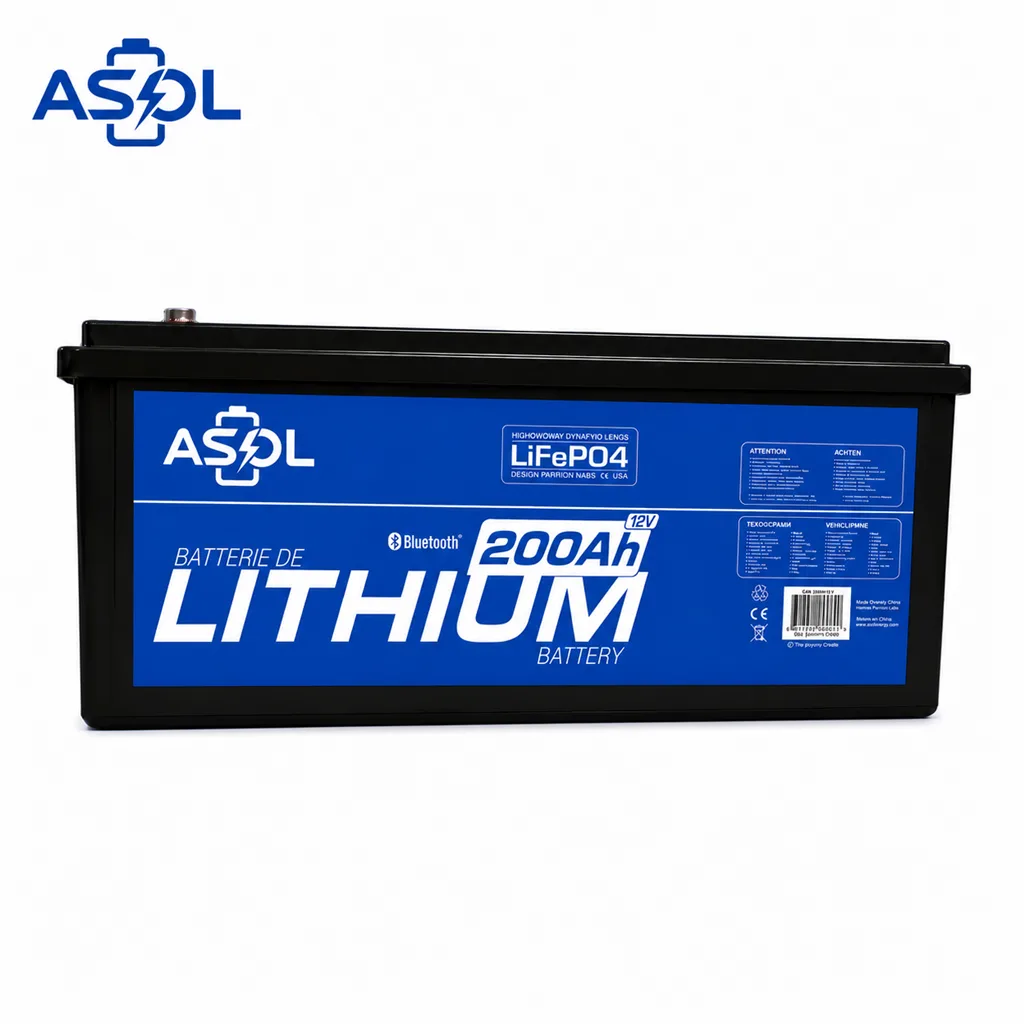
Balanced capacity option for camper vans and medium-capacity RV electrical systems.
- 12.8V
- 200Ah
- 2.56kWh
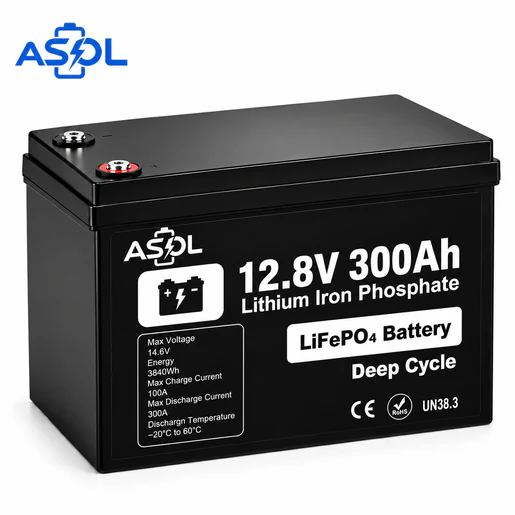
High-capacity option for RV and camper systems requiring greater stored energy and high-current capability.
- 3.84kWh
- 300A continuous
- 400A peak / 10s
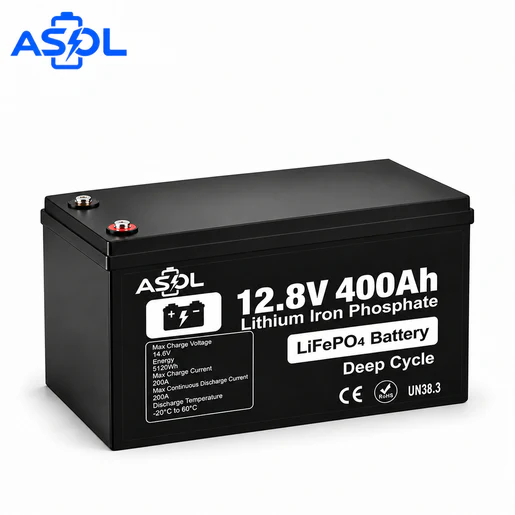
Large-capacity option for RV and off-grid applications requiring extended stored energy.
- 12.8V
- 400Ah
- 5.12kWh
24V Standalone RV Batteries
LiFePO4 battery options for 24V camper, caravan and motorhome electrical platforms.
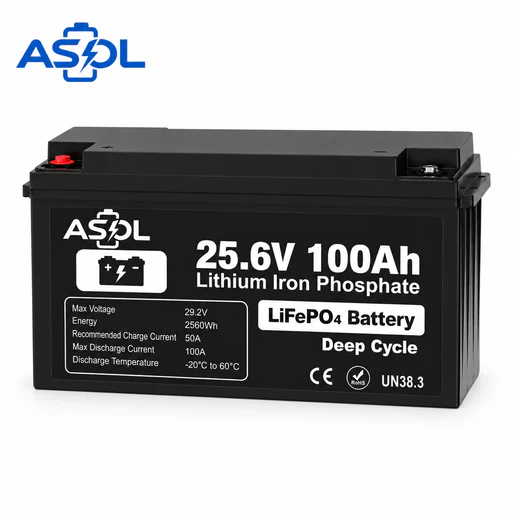
Standalone LiFePO4 battery for 24V RV, camper and caravan electrical systems.
- 25.6V
- 100Ah
- 2.56kWh
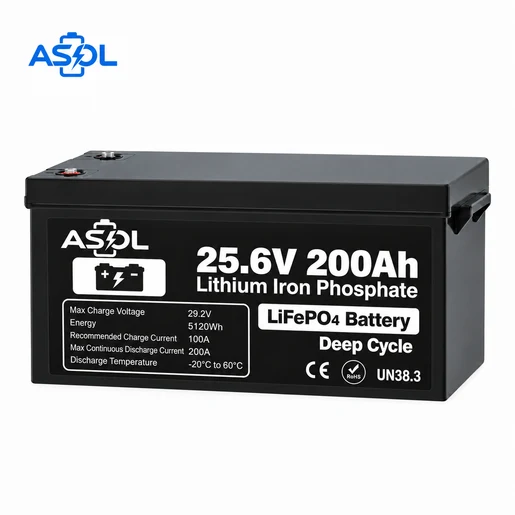
Higher-energy standalone battery option for 24V RV and motorhome power systems.
- 25.6V
- 200Ah
- 5.12kWh
36V & 48V Deep-Cycle Batteries
LiFePO4 battery options for compatible higher-voltage deep-cycle and lead-acid replacement systems.
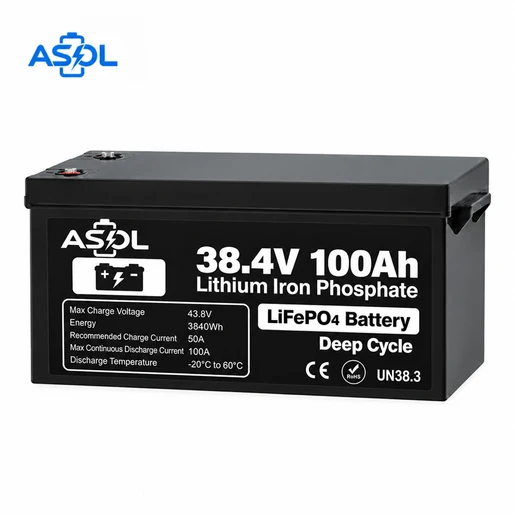
Deep-cycle LiFePO4 option for compatible 36V-class power and lead-acid replacement systems.
- 38.4V
- 100Ah
- 3.84kWh
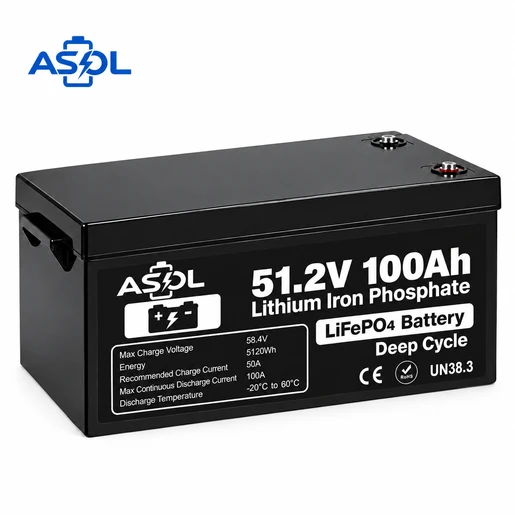
Deep-cycle LiFePO4 option for compatible 48V-class lead-acid replacement and project-based power systems.
- 51.2V
- 100Ah
- 5.12kWh
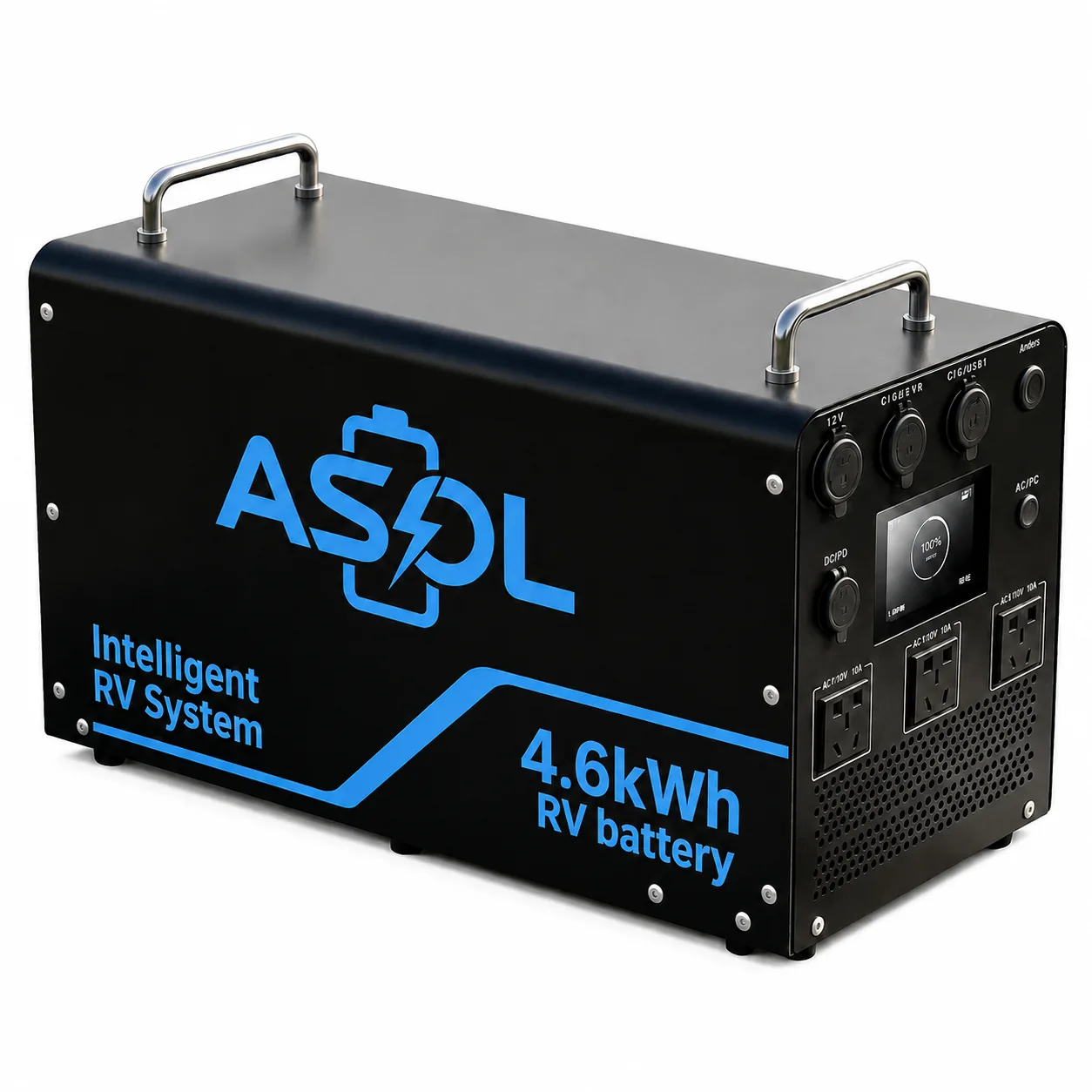
Integrated RV Power System
For RV projects that require a more integrated power architecture rather than a standalone battery configuration.
Quick LiFePO4 Battery Selection Guide
Final battery selection depends on system voltage, inverter and load requirements, charging configuration, required runtime, installation space and project design.
Not Sure Which RV Battery Fits Your System?
Tell us your system voltage, inverter or load requirements, required capacity or runtime, installation constraints and estimated quantity.
For RV Manufacturers & Van Builders
RV Battery Options
ASOL RV battery options include 12.8V LiFePO4 batteries in 100Ah, 200Ah, 300Ah and 400Ah capacities, plus 25.6V 100Ah and 200Ah configurations for compatible 24V-class RV and caravan systems. For compatible higher-voltage or project-based systems, 38.4V 100Ah and 51.2V 100Ah LiFePO4 configurations are also available.
OEM / Private Label Support
Battery configuration, labeling, branding and packaging can be reviewed based on project requirements.
How to Evaluate an RV Lithium Battery Supplier
1. Start with the RV Electrical System, Not the Battery Catalog
A qualified supplier should first ask about system voltage, inverter continuous and surge demand, shore and solar charging, alternator or DC-DC charging, installation space, terminals, operating temperature and expected production quantity. Recommending a stock model before these inputs are understood creates compatibility risk.
2. Separate Standard, Adjusted and Project-Specific Configurations
Clarify whether the project can use an existing standard battery, needs a limited adjustment such as terminals or monitoring, or requires a project-specific electrical and mechanical design. Not every voltage, enclosure, communication feature or certification combination is feasible, so the supplier should define the engineering boundary early.
3. Review Cell and BMS Engineering
Ask the supplier to confirm the selected chemistry and cell format, continuous and peak discharge capability, charging current, protection functions, balancing, temperature requirements and any communication interface. Ratings should be tied to the final configuration rather than assumed from a similar catalog model.
4. Confirm Mechanical Integration
Provide maximum dimensions, terminal location, polarity, mounting, cable direction, enclosure constraints, service access and environmental requirements. The approved drawing should make these interfaces clear before a sample is released.
5. Define the Sample-to-Production Process
A practical sequence is approved sample configuration, installation in the actual RV system, customer validation, final specification confirmation and controlled production release. Runtime, current, charging, mechanical fit and communication should be checked in the real application where relevant. Later changes should be documented and approved rather than silently substituted.
6. Ask for Relevant Quality and Test Evidence
Depending on the project, a buyer can ask how incoming materials are inspected, how production is controlled, which BMS and electrical functions are tested, how final inspection is recorded and how capacity or other agreed tests are handled. Evidence should relate to the ordered model and process, not only to a general factory presentation.
7. Verify Documentation for the Final Configuration
Transport and market documentation depends on the final model, configuration, application and destination. Confirm which reports or declarations apply to the exact battery being ordered. MSDS is documentation rather than a universal product certification, and UN38.3 does not by itself establish approval for every destination or application.
8. Review OEM Support, Warranty and Repeat Orders
Confirm label and private-label scope, packaging, project communication, production lead time and the warranty terms applicable to the selected configuration. For repeat orders, ask how drawings, BMS settings, approved components and change records are controlled so the delivered configuration remains consistent with the approved sample.
9. Use a Supplier Evaluation Checklist
| Evaluation area | What the buyer should confirm |
|---|---|
| Electrical compatibility | Voltage, charging sources, inverter and continuous/peak demand. |
| Cell and BMS configuration | Chemistry, protection, thermal and communication requirements. |
| Mechanical fit | Dimensions, terminals, mounting, cabling and enclosure. |
| Sample and validation | Approved configuration, real-system tests and acceptance criteria. |
| QC and testing | Relevant incoming, production, electrical and final inspection evidence. |
| Documentation | Requirements verified by final model, destination and application. |
| OEM support | Label, branding, packaging and approved configuration scope. |
| Commercial continuity | Warranty, lead time, issue communication and repeat-order control. |
Before contacting a supplier, prepare the project inputs in the technical battery RFQ guide. Buyers comparing available configurations can also review ASOL's 12.8V 300Ah and 12.8V 400Ah LiFePO4 battery pages without assuming that either model fits every RV system.
RV Battery System Considerations
Battery capacity alone does not determine whether an RV battery is suitable. The battery must match the complete vehicle electrical system and expected energy use.
- RV system voltage
- Required usable energy and daily runtime
- Continuous and peak appliance load
- Inverter power and surge demand
- AC charger specifications
- Alternator or DC-DC charging specifications
- Solar-controller charging parameters
- Available installation space
- Terminal type and cable routing
- Ambient and operating temperature
- Monitoring or communication requirements
- Estimated order quantity and destination
The selected battery must be evaluated together with the charger, inverter, solar controller, DC-DC charger and connected loads. See ASOL’s RV lithium battery selection guide.
RV Electrical-System Compatibility
An RV LiFePO4 battery should not be assumed to be a universal direct replacement for every lead-acid or AGM battery. Nominal voltage, charging profile, continuous and peak current, low-voltage cutoff, terminal arrangement and physical installation must be compatible with the vehicle.
| Item | Information to confirm |
|---|---|
| System voltage | Existing RV electrical-system voltage |
| Battery capacity | Required runtime and usable-energy demand |
| Continuous load | Normal appliance and inverter demand |
| Peak load | Starting and surge current |
| AC charging | Charger model, output voltage and charging profile |
| Alternator charging | Alternator or DC-DC charger specification |
| Solar charging | Solar-controller model and LiFePO4 charging parameters |
| Connection | Whether series or parallel operation is required |
Series or parallel capability depends on the specific battery model, BMS and approved configuration. The permitted connection method and maximum number of connected batteries must be confirmed before installation. For compatible lead-acid replacement projects, see the RV lithium battery vs. lead-acid battery guide.
Installation and Mechanical Requirements
Mechanical compatibility includes the battery dimensions, terminal location, polarity, mounting method, cable access, ventilation, service clearance and vehicle operating environment.
Please confirm:
- Maximum available length, width and height
- Battery orientation and mounting position
- Terminal type, location and polarity
- Cable and fuse requirements
- Vibration and impact conditions
- Ventilation and service access
- Ambient and operating temperature
- Required enclosure or ingress protection
A battery that fits the available compartment may still be unsuitable if its electrical, charging or environmental requirements are not compatible.
BMS, Monitoring and Optional Functions
BMS and monitoring requirements depend on the selected battery model, system voltage, current and RV project. Depending on the product or approved configuration, available functions may include:
- Overcharge and over-discharge protection
- Overcurrent and short-circuit protection
- Temperature monitoring
- Cell-balancing requirements
- Bluetooth monitoring
- CAN or RS485 communication
- State-of-charge display
- Low-temperature charging protection or heating
These functions are not standard on every ASOL RV battery. Availability must be confirmed for the selected product.
OEM / ODM Battery Configuration
Configurations can be evaluated according to the electrical, mechanical and application requirements of the project. Depending on project feasibility, available options may include:
- Voltage and capacity
- BMS current and continuous / peak discharge
- Bluetooth / APP monitoring where required
- Terminals, wiring and connectors where applicable
- Enclosure, mounting and IP requirements
- Labels, logo and packaging
- Project-specific documentation
Not every option is available for every product. Final specifications, MOQ, price and lead time are confirmed after the requirements have been reviewed.
Single-unit initial orders are accepted for RV battery products and are handled as sample orders. Pricing, lead time and shipping arrangements are confirmed according to the selected battery configuration, quantity and delivery destination.
Quality, Testing and Documentation
Quality checks and documentation requirements depend on the selected RV battery, configuration, order and destination market. Applicable checks may include appearance and dimensional inspection, voltage and capacity testing, BMS function checks, protection testing and final battery inspection.
Available certifications, transport test reports and compliance documents must be confirmed for the specific battery model, configuration and destination before ordering. Do not assume that every RV battery carries the same certification set.
Information Required for a Quotation
To evaluate an RV battery project, please provide:
- RV, camper or vehicle type
- Existing battery model or specification
- Required system voltage
- Required capacity or daily energy use
- Continuous and peak load
- Inverter model and rated power
- AC charger specification
- Alternator or DC-DC charger information
- Solar-controller information, if applicable
- Maximum installation dimensions
- Terminal and cable requirements
- Monitoring or communication requirements
- Estimated order quantity
- Delivery destination
Photos of the existing battery, installation compartment, battery label and electrical-system diagram can also help with compatibility review.
Frequently Asked Questions
What RV LiFePO4 batteries does ASOL provide?
ASOL provides 12.8V LiFePO4 batteries in 100Ah, 200Ah, 300Ah and 400Ah capacities, plus 25.6V 100Ah and 200Ah batteries. For compatible higher-voltage deep-cycle and lead-acid replacement systems, 38.4V 100Ah and 51.2V 100Ah options are also available. Project-specific battery and RV power configurations can be evaluated for B2B applications.
Can an ASOL RV battery directly replace my lead-acid or AGM battery?
Compatibility should not be assumed. The system voltage, charger, load current, terminals, dimensions, mounting and operating conditions must be reviewed before selecting a replacement battery.
Can I use my existing RV charger or inverter?
The charger and inverter specifications must be reviewed for compatibility with the selected battery. Please provide the model, charging voltage, charging profile, rated power and surge requirements.
Can the battery work with an RV solar system?
Solar compatibility depends on the selected battery and solar-controller charging parameters. The controller model, charging voltage and charging profile must be confirmed before installation.
Do all ASOL RV batteries include Bluetooth, heating or communication?
No. Monitoring, heating, display and communication functions vary by product and configuration. Available functions must be confirmed for the selected battery.
Can ASOL RV batteries be connected in series or parallel?
Series or parallel capability depends on the specific battery model, BMS and approved configuration. The permitted connection method and maximum number of connected batteries must be confirmed before installation.
Can I order one RV battery for evaluation?
Yes. A single-unit initial order can be accepted and will be handled as a sample order. Pricing, lead time and shipping arrangements are confirmed according to the selected battery configuration and delivery destination.
What certifications are available?
Available certifications, transport test reports and compliance documents depend on the selected RV battery, configuration and destination market. Applicable requirements must be confirmed before ordering.
What information is required for an RV battery quotation?
Please provide the vehicle type, existing battery specification, voltage, capacity or energy requirement, continuous and peak load, charger and inverter details, installation dimensions, terminals, quantity and destination.
How are MOQ, price and lead time confirmed?
MOQ, pricing and lead time depend on the selected battery, configuration, customization requirements, quantity and destination. They are confirmed after the project requirements have been reviewed.
Evaluate Your RV Battery Project
RV manufacturers, van builders, distributors and OEM buyers can share the electrical system, charging sources, continuous and peak load, installation constraints, validation plan and expected quantity for a project review.
U.S. warehouse support is available for selected RV LiFePO4 battery models, helping support faster local delivery and more flexible small-batch purchasing. Availability must be confirmed for the selected model.
Discuss Your Battery Project
Email: info@asolbattery.com
WhatsApp: +86 157 7985 8703