RV Lead-Acid Replacement Guide
Table of Contents
Replacing an RV lead-acid or AGM bank with LiFePO4 is a system-compatibility decision, not a nominal-voltage substitution. Lithium can provide more usable energy for a given rated capacity, lower weight and reduced routine maintenance, but the existing charger, alternator path, inverter, cabling, protection and installation space must be reviewed first.
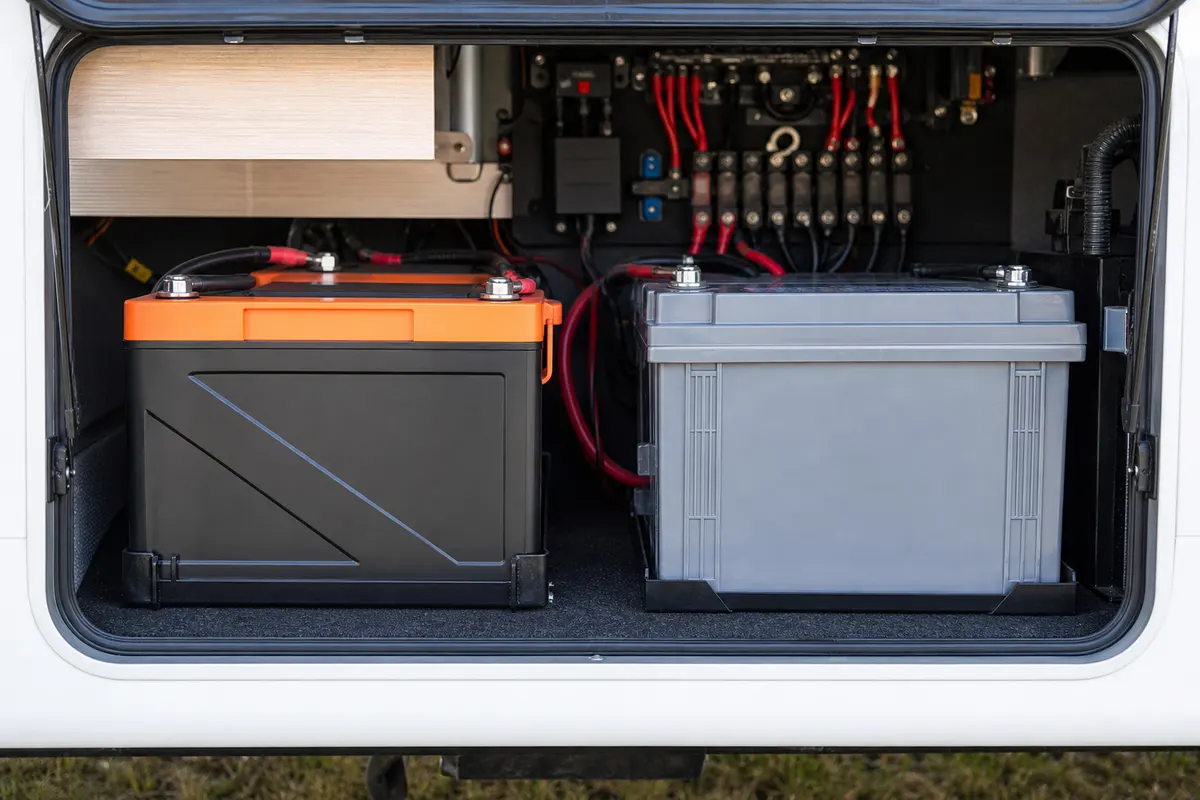
1. Practical Technology Comparison
| Decision factor | Lead-acid or AGM | LiFePO4 |
|---|---|---|
| Usable energy | Usable capacity is limited by battery type, depth of discharge and condition. | A larger share of rated energy may be usable, subject to the selected battery specification and BMS limits. |
| Weight | Generally heavier for a comparable nominal energy rating. | Generally lower weight, but verify the actual selected model. |
| Charging behavior | Uses a lead-acid charging profile with absorption and maintenance behavior. | Requires charging settings approved for the selected LiFePO4 battery. |
| Current capability | Depends on battery construction, condition and bank design. | Depends on cells, BMS, terminals and the approved configuration. |
| Maintenance | Flooded batteries need periodic service; AGM reduces routine maintenance. | Normally sealed, with monitoring and service requirements depending on the model. |
| Low-temperature charging | Performance still changes with temperature. | Requires model-specific low-temperature charging control; heating is not universal. |
2. Before Replacing an RV Lead-Acid Battery with LiFePO4, Check These Items
Lead-acid replacement should be evaluated against the existing RV electrical system rather than assumed from nominal voltage alone.
- System voltage: confirm nominal and operating voltage across the battery bank and connected equipment.
- Charger profile: record shore charger model, output settings and whether an approved LiFePO4 profile is available.
- Alternator and DC-DC path: confirm how charging current is controlled and whether the alternator is protected.
- Inverter demand: document continuous power and startup or surge requirements.
- Compartment dimensions: measure maximum length, width and height plus service clearance.
- Terminals: confirm type, position, polarity and cable direction.
- Cables and fuses: review conductor size, branch protection, disconnects and fuse ratings.
- Temperature: define expected charging and storage conditions.
- Bank architecture: confirm any series or parallel requirement with the selected model.
- Monitoring: identify display, Bluetooth or communication needs where relevant.
3. Charger, Alternator and Solar Compatibility
Do not assume an existing lead-acid charger is suitable because nominal voltage appears similar. Compare its charging stages, voltage limits and current with the selected battery specification. Alternator charging should be reviewed separately; a suitable DC-DC charger or other current-control method may be required. Solar-controller settings must also match the battery's approved charging parameters.
4. Inverter and Current Requirements
The replacement battery and BMS must support normal continuous demand and short startup loads. Provide the inverter model, rated power, surge requirement and expected simultaneous appliances. Capacity alone does not establish current capability.
5. Mechanical and Protection Requirements
Check compartment dimensions, mounting, terminal access, cable bend radius and environmental requirements. A new battery may require revised cables, fuses, busbars or hold-down arrangements. Series and parallel operation is model-specific and must be confirmed rather than inferred from the previous bank.
6. Low-Temperature Charging
For cold climates, determine whether low-temperature charge protection is sufficient or whether an approved self-heating configuration is needed for regular winter charging. These functions vary by model. The installation should also consider where temperature is measured and which charging sources remain active in cold conditions.
7. Decide from the Complete System
Lead-acid may remain practical for occasional use, an unchanged legacy charging system or a tightly constrained initial budget. LiFePO4 may be preferred where usable energy, weight, frequent cycling and reduced routine maintenance matter, provided the electrical and mechanical integration is compatible.
For system-level capacity and load planning, use the RV lithium battery selection guide. ASOL's LiFePO4 lead-acid replacement solutions provide a commercial starting point, but final compatibility remains configuration-specific.
Plan Your Battery Project
Continue with the relevant product range, application requirements and an example battery solution.
Request a Quote