Battery Knowledge
This battery cell selection guide helps OEM engineers, buyers and product teams define the requirements that affect real product design, including cell format, chemistry, pack structure, protection and testing.
The purpose is to help B2B customers communicate more clearly with a battery manufacturer before starting a custom battery pack project.
For a detailed explanation of how series and parallel count affect 18650 pack voltage, capacity and design, see our 18650 battery pack series and parallel configuration guide.
For a direct format-by-format comparison, see 18650 vs 21700 vs LiFePO4 pouch cell.
Table of Contents
1. Basic Concept
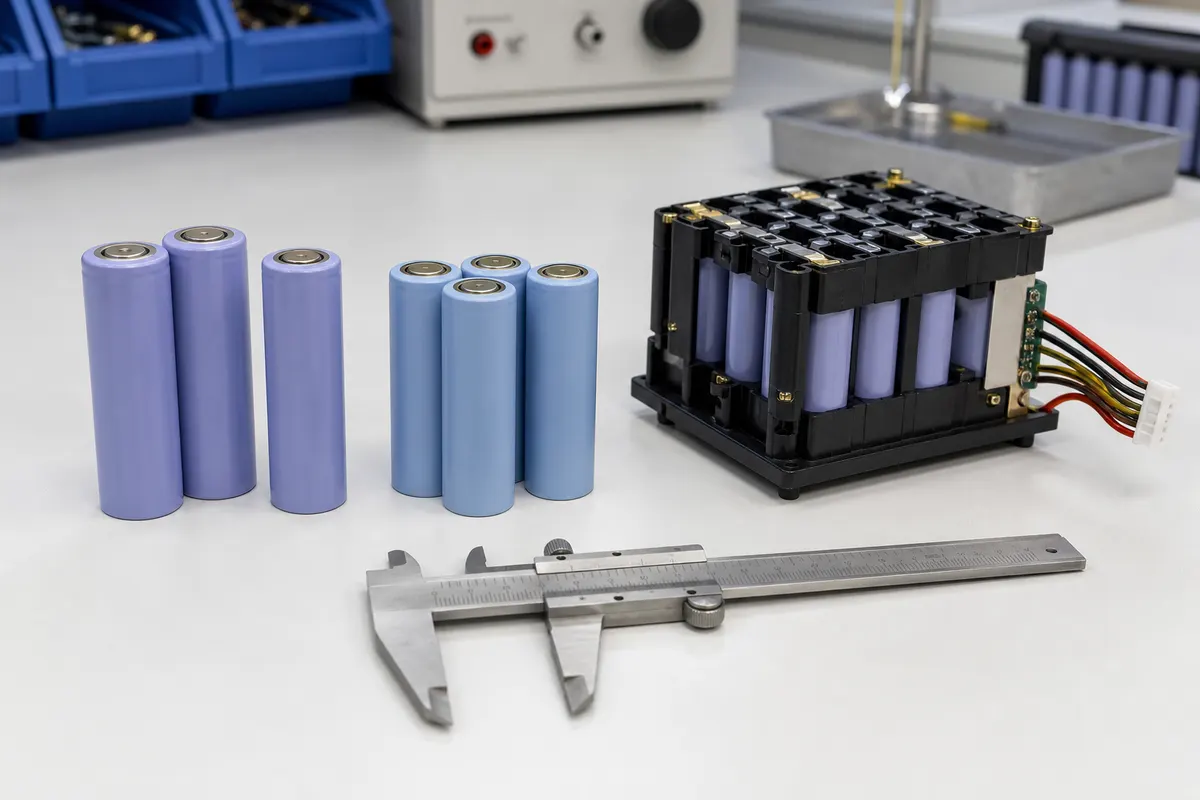
A lithium battery cell is the basic energy unit. A battery pack combines one or more cells with protection, wiring, insulation, label and connector. The finished pack must match the device load and charging environment.
2. Cell Chemistry and Format
Common formats include cylindrical Li-ion cells such as 18650 and 21700, lithium polymer pouch cells, and LiFePO4 cells. Each format has different advantages for capacity, size, cycle life, discharge current and mechanical design.
| Format | Typical use |
|---|---|
| 18650 / 21700 cells | Portable equipment, instruments, lighting and multi-series cylindrical packs. |
| Lithium polymer cells | Thin devices or custom-shaped battery spaces. |
| LiFePO4 cells | Lead-acid replacement, RV, backup and long-cycle energy applications. |
3. Battery Pack Structure
Series cells increase voltage, while parallel cells increase capacity and current capability. The pack also needs nickel strips, insulation, a PCM or BMS, wires, connector and mechanical protection.
4. Safety and Testing
Safety design should include over-charge, over-discharge, over-current and short-circuit protection. For demanding applications, temperature monitoring, cell balancing and aging tests may also be needed.
5. How to Apply This Knowledge
Use this knowledge to prepare the project requirements: voltage, capacity, current, size, connector, charging method and working environment. ASOL can then recommend a suitable battery pack structure.
18650 / 21700 Pack Calculation: Series First, Then Parallel
Use the cell nominal voltage and capacity to develop a starting pack structure. The final design still needs cell discharge capability, BMS limits, heat, connection method and enclosure space checked by engineering.
Parallel count = target capacity ÷ cell capacity
Example: 14.8V, 10Ah from 3.7V, 5Ah cells starts as 4S2P (8 cells).
| Format | Best starting point | Check before selection |
|---|---|---|
| 18650 | Balanced size and design flexibility | Cell current, pack layout and cell availability. |
| 21700 | Higher energy per cell for many designs | Available space, weight and the required discharge rate. |
| Cylindrical pack | Robust multi-cell assemblies | Nickel connection, insulation, BMS, fuse and wiring path. |
Common Pack Design Errors
- Using voltage and capacity math without checking the required peak current per parallel cell.
- Selecting a cell by mAh only, rather than its permitted continuous discharge.
- Leaving connector, wire length and battery-bay dimensions until after the electrical design.
Frequently Asked Questions
What is the difference between a cell and a battery pack?
A cell is a single energy unit. A pack combines cells with protection circuits, wiring, insulation and connectors for use in a finished device.
Why are 18650 and 21700 cells common in custom packs?
They offer stable supply, flexible series/parallel assembly and good mechanical strength for many portable and industrial products.
When should lithium polymer cells be used?
Lithium polymer cells are useful when the device needs a thin battery or a custom shape that cylindrical cells cannot fit.
Send Your Battery Requirements
For project evaluation, share your target voltage, capacity, size limit, load current, connector requirement, application details and expected quantity. ASOL can review the cell structure, BMS/PCM, wiring and sample plan before mass production.
Plan Your Battery Project
Continue with the relevant product range, application requirements and an example battery solution.
Request a Quote