RV Battery Guide
Choosing an RV lithium battery starts with the electrical system, not just the amp-hour label. A suitable LiFePO4 battery must match the RV voltage, daily energy use, inverter demand, charging equipment, installation space and expected climate.
This guide helps RV builders, converters, distributors and fleet buyers create a clear battery brief before selecting a standard model or requesting an OEM configuration.
Table of Contents
- 1. Confirm the RV System Voltage
- 2. Separate Energy Capacity from Power Capability
- 3. Match Continuous and Peak Loads
- 4. Compare One Large Battery with a Parallel Bank
- 5. Check Charger, Alternator and Solar Compatibility
- 6. Plan for Cold-Weather Operation
- 7. Review Installation and Protection
- 8. Prepare a Practical RV Battery Brief
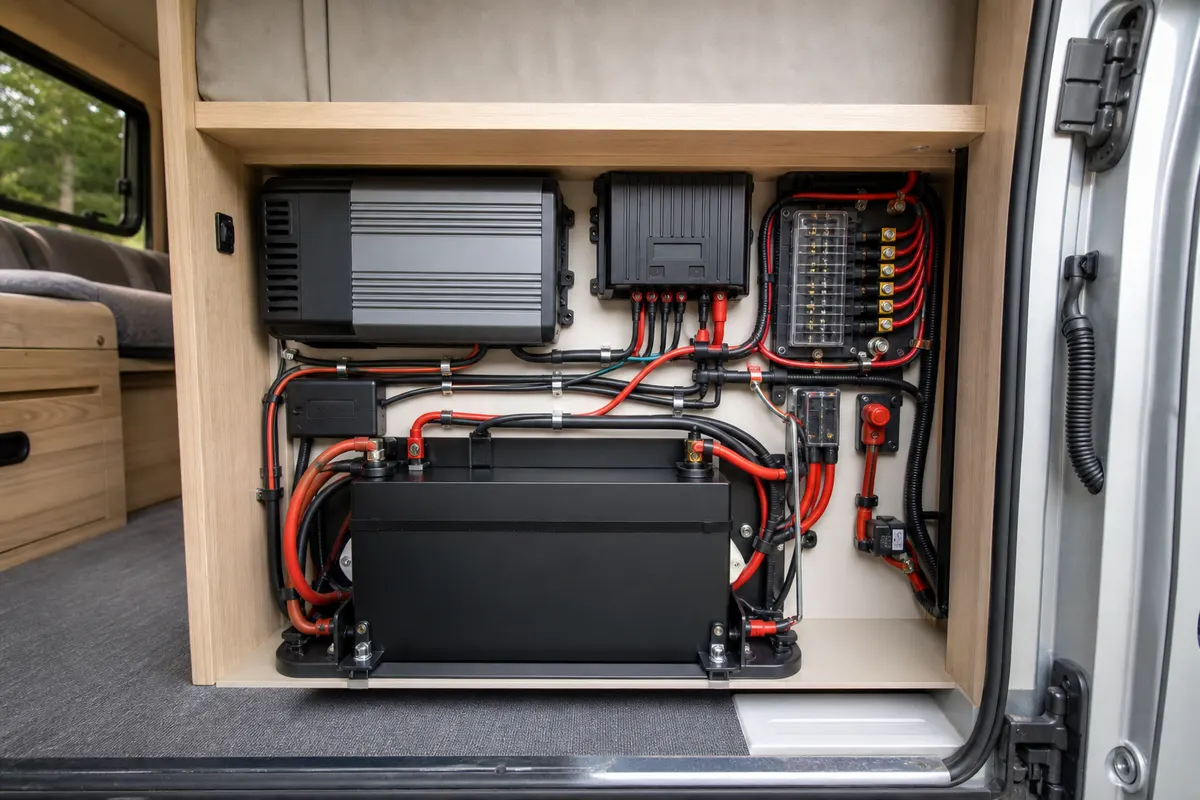
1. Confirm the RV System Voltage
Most RV auxiliary systems use a nominal 12V battery, while larger motorhomes, high-power inverters and multi-battery banks may use 24V or 48V. The battery voltage must work with the inverter, DC loads, charger and solar controller. Do not replace a 12V lead-acid battery with a higher-voltage lithium pack unless the complete system has been designed for it.
| System | Typical use | Selection note |
|---|---|---|
| 12V LiFePO4 | Camper vans, trailers and auxiliary power | Common choice for direct lead-acid replacement and moderate inverter loads. |
| 24V LiFePO4 | Larger RVs and higher-power systems | Reduces current for the same power and can simplify cabling. |
| 48V LiFePO4 | High-power mobile or off-grid systems | Usually requires a purpose-designed inverter and charging architecture. |
2. Separate Energy Capacity from Power Capability
Amp-hours and watt-hours describe stored energy. They help estimate how long an RV system may operate, but they do not by themselves show whether a battery can supply a demanding inverter or a short startup surge. Runtime must be evaluated from the actual duty cycle, system losses, reserve and operating conditions rather than promised from capacity alone.
Power capability also depends on the cells, BMS continuous and peak discharge limits, terminals, interconnects, cabling and fuse selection. A high-capacity battery can still be unsuitable when its approved current capability does not match the load.
If you are comparing specific battery sizes, see our guide to choosing between 100Ah, 200Ah, 300Ah and 400Ah RV LiFePO4 batteries.
3. Match Continuous and Peak Loads
Continuous current is the sustained demand from the system during normal operation. Peak current is the shorter startup or surge demand created by equipment such as an inverter, air-conditioner compressor, microwave, induction load or pump. Both must remain within the approved battery and BMS configuration.
Share the inverter rating, expected simultaneous loads and any surge-current data with the battery supplier. This helps determine whether a standard RV lithium battery, a parallel bank or a custom BMS configuration is appropriate.
4. Compare One Large Battery with a Parallel Bank
| Approach | Practical considerations |
|---|---|
| One larger battery | Can simplify wiring and protection, but the available compartment, lifting access, terminal position and model-specific current capability must fit the installation. |
| Parallel battery bank | Can distribute capacity across available spaces, but adds cables, branch protection and current-sharing requirements. Cable lengths and resistance should be balanced. |
Only batteries approved for the intended parallel configuration should be combined. Confirm model matching, BMS limitations, battery condition, state-of-charge alignment and connection procedure. Batteries from the same production batch are preferable where the manufacturer recommends it; there is no universal ASOL parallel limit.
5. Check Charger, Alternator and Solar Compatibility
A LiFePO4 battery should be paired with a suitable charging profile. Review shore charger voltage, alternator/DC-DC charging current and solar-controller settings before installation. A system may need a DC-DC charger or current limitation to protect the alternator and manage the lithium battery correctly.
- Confirm the charger has a lithium-compatible profile or adjustable setpoints.
- Check solar-controller voltage settings and maximum charge current.
- Review alternator charging separately, especially for high-capacity battery banks.
- Consider low-temperature charging protection where the RV operates in cold conditions.
6. Plan for Cold-Weather Operation
Low-temperature charge protection and self-heating solve different requirements. Charge protection stops or limits charging when cell temperature is outside the approved range. Self-heating uses available energy to warm a compatible battery before charging.
For occasional freezing conditions, model-specific charge protection may be sufficient. Regular winter operation may justify an approved self-heating configuration, but heating is not standard on every battery and must be confirmed for the selected model and charging system.
7. Review Installation and Protection
Before ordering, measure the battery compartment and confirm mounting, service access, cable routes, fuse location, terminal orientation and environmental exposure. The selected cables, terminals and protection devices must suit the system current and installation requirements.
8. Prepare a Practical RV Battery Brief
Provide the current battery label or group size, system voltage, daily energy requirement, inverter and charger details, alternator/DC-DC and solar configuration, continuous and peak load, available space, terminal style, operating temperature, destination market and expected quantity.
If the project involves replacing AGM or flooded lead-acid batteries, review the RV lead-acid to LiFePO4 compatibility checks. Professional buyers comparing development and supply capabilities can use the RV lithium battery manufacturer evaluation guide.
RV Battery Sizing Workflow
Use watt-hours to document daily energy, autonomy and reserve assumptions, then verify that the selected configuration also supports the required current and charging sources.
Common RV Selection Errors
- Choosing Ah without checking inverter startup current or the BMS continuous-current rating.
- Assuming an alternator can safely charge a large lithium bank without DC-DC current control.
- Ignoring compartment dimensions, terminal orientation or cold-weather charging requirements.
Frequently Asked Questions
Is a 12V lithium battery always the best choice for an RV?
No. A 12V battery is common for RV auxiliary systems, but 24V or 48V can be more suitable when the full electrical system is designed for higher power.
Can I use my existing lead-acid charger?
Check its charging profile and voltage settings first. A lithium-compatible charger or adjustable charger is often the safer choice for LiFePO4 batteries.
What information does ASOL need for an RV battery quotation?
System voltage, capacity target, inverter and charger details, load current, installation dimensions, operating temperature, terminals and quantity are the most useful starting details.
Explore RV Battery Solutions
For product configurations and OEM options, explore ASOL's RV lithium battery range. For a complete RV or camper power-system brief, see our RV & camper battery solutions.
Share Your RV System Requirements
Plan Your Battery Project
Continue with the relevant product range, application requirements and an example battery solution.
Request a Quote