OEM/ODM Guide
For a detailed explanation of 1S-6S layouts and combined S/P architectures, see our 18650 battery pack configuration guide.
Table of Contents
- 1. What a BMS Actually Does
- 2. Step 1: Define the Pack Configuration First
- 3. Step 2: Match Current Rating to Real-World Load
- 4. Step 3: Decide What Balancing You Actually Need
- 5. Step 4: Determine Communication Requirements
- 6. Step 5: Confirm Protection Thresholds Match Cell Specifications
- 7. Step 6: Consider Certification Requirements Early
- 8. A Practical Checklist Before Finalizing Your BMS
- 9. Working with a Manufacturer on BMS Selection
The Battery Management System (BMS) is arguably the most important — and most overlooked — decision in a custom battery pack project. Choosing the wrong BMS can mean a battery that underperforms, fails prematurely, or doesn't meet certification requirements, even if the cells themselves are high quality. Here's how to think through the selection.
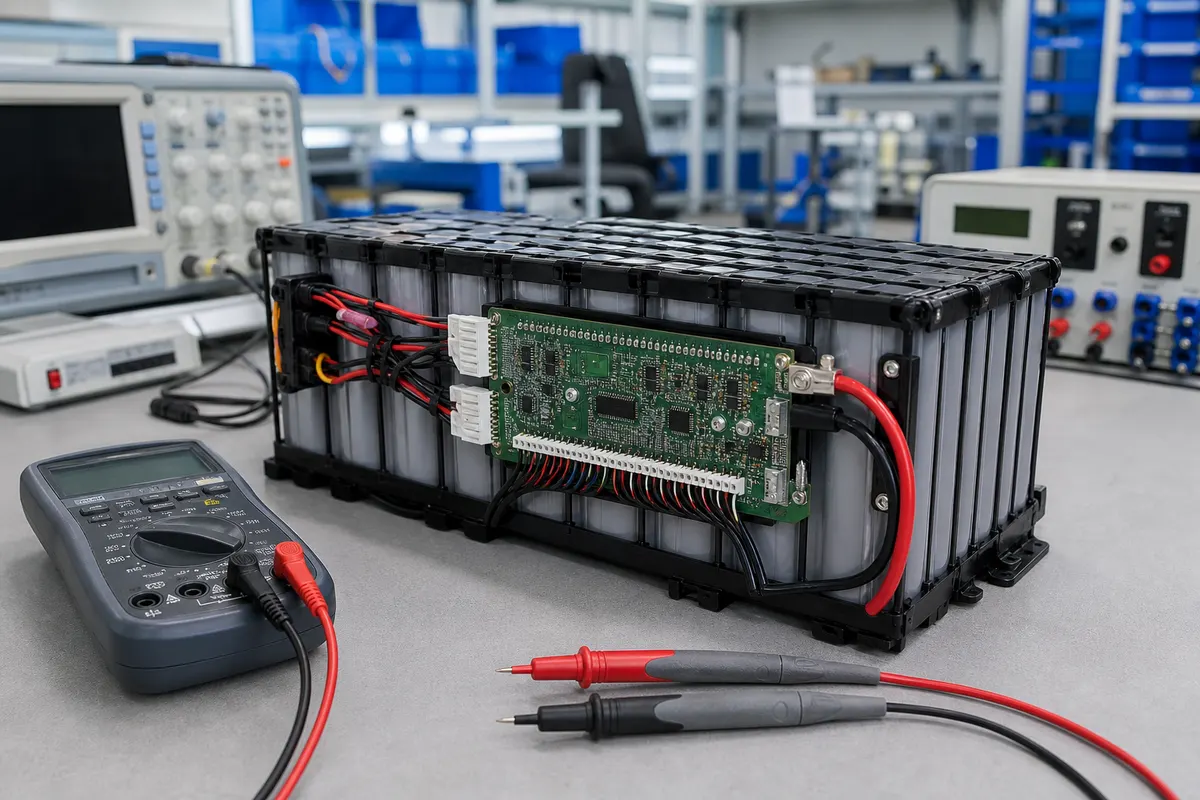
1. What a BMS Actually Does
A BMS sits between the cells and the outside world and handles:
- Protection — overcharge, over-discharge, over-current, short-circuit and (for lithium chemistries) over-temperature protection
- Cell balancing — keeping individual cells in a series string at the same voltage/state of charge so the pack doesn't degrade unevenly
- State of Charge (SOC) monitoring — estimating remaining capacity, often shown via LED indicator, LCD, or app
- Communication — for packs that need to "talk" to an inverter, charger, vehicle ECU or fleet monitoring system (via UART, RS485, CAN bus, Bluetooth, etc.)
A BMS that only does protection is cheaper. A BMS that also does balancing, SOC reporting and communication costs more — but is often necessary depending on the application.
2. Step 1: Define the Pack Configuration First
BMS selection starts with your cell configuration, not the other way around:
- Series count (S): How many cells in series determines pack voltage (e.g., 4S = 12.8V LiFePO4, 13S = 48V LiFePO4)
- Parallel count (P): How many cell groups in parallel determines capacity and max discharge current
- Chemistry: LiFePO4, standard Li-ion, or Lithium Polymer each have different voltage cutoffs and balancing requirements — see our guide to choosing the right cell format if this hasn't been decided yet
A BMS rated for the wrong series count simply won't work — this needs to be locked down before BMS selection begins.
3. Step 2: Match Current Rating to Real-World Load
This is the most common mistake in custom battery projects: choosing a BMS rated close to the *average* load rather than the *peak* load.
Ask:
- What is the continuous discharge current the device draws?
- What is the peak/surge current (e.g., motor start-up, inverter surge load)?
- Does the application also require high-current charging (e.g., regenerative braking, fast DC charging)?
A BMS should generally be rated with headroom above the peak current draw — running a BMS at its rated maximum continuously shortens its service life and increases heat generation inside the pack.
4. Step 3: Decide What Balancing You Actually Need
- Passive balancing (resistor-based) is the standard, cost-effective option for most consumer and light industrial applications. It bleeds excess energy from higher-voltage cells as heat.
- Active balancing transfers energy between cells rather than dissipating it, improving efficiency and pack longevity — typically used in higher-value packs (larger ESS systems, higher-cycle-count applications) where the added cost is justified by better capacity utilization and lifespan.
For most RV, robotics, and consumer device packs, passive balancing is sufficient. For large-format energy storage or high-cycle industrial applications, active balancing is worth the additional cost.
5. Step 4: Determine Communication Requirements
Ask what the battery needs to "talk to," if anything:
- Standalone pack, no external communication needed → simple protection-only or protection + LED SOC BMS
- Needs to report SOC/health to an app → Bluetooth-enabled BMS
- Integrates with a solar inverter, charge controller, or vehicle system → RS485 or CAN bus BMS with the correct communication protocol matched to the receiving device
- Fleet or industrial monitoring → CAN bus with data logging capability, sometimes combined with cloud connectivity
Getting this wrong is a common cause of project delays — confirm the communication protocol with the end-device manufacturer *before* finalizing BMS selection, not after.
6. Step 5: Confirm Protection Thresholds Match Cell Specifications
Every BMS should be configured (not just selected) to match the specific cell chemistry's voltage limits:
| Parameter | LiFePO4 (per cell) | Standard Li-ion (per cell) |
|---|---|---|
| Overcharge cutoff | ~3.65V | ~4.2V |
| Over-discharge cutoff | ~2.5V | ~2.75–3.0V |
| Balancing start voltage | ~3.4–3.5V | ~3.9–4.0V |
Using a generic BMS with mismatched thresholds is one of the most common causes of premature cell degradation in custom packs — this is a configuration step, not just a purchasing decision.
7. Step 6: Consider Certification Requirements Early
If the finished battery needs to ship internationally or be sold under regulatory requirements (UN38.3, CE, UL, RoHS), the BMS design and protection thresholds need to be documented and tested as part of the pack, not added afterward. Specifying certification requirements at the start of the project avoids costly re-design later.
8. A Practical Checklist Before Finalizing Your BMS
- Series/parallel configuration confirmed
- Continuous and peak current requirements documented
- Balancing type selected (passive vs. active) based on use case
- Communication protocol confirmed with end-device manufacturer (if applicable)
- Voltage protection thresholds matched to cell chemistry
- Target certifications identified (UN38.3, CE, UL, etc.)
9. Working with a Manufacturer on BMS Selection
For most custom battery pack projects, the fastest path is to share your application details — voltage, capacity, peak current, communication needs and target certifications — with your battery pack manufacturer's engineering team, rather than choosing a BMS in isolation. ASOL's engineering team reviews voltage, capacity, BMS/PCM matching, wiring and connector requirements for every custom pack project to make sure the BMS is correctly specified for the real-world load, not just the nameplate rating.
Discuss your BMS and custom pack requirements →
Plan Your Battery Project
Continue with the relevant product range, application requirements and an example battery solution.
Request a Quote