Battery Knowledge
Table of Contents
- 1. 12V vs 24V RV Battery System: Quick Comparison
- 2. Why Does RV Battery System Voltage Matter?
- 3. 12.8V LiFePO4 Battery Options for RV Systems
- 4. 25.6V LiFePO4 Battery Options for 24V-Class RV Systems
- 5. Inverter Power Can Influence the 12V vs 24V Decision
- 6. Compare RV Battery Capacity in kWh, Not Only Ah
- 7. Charging Compatibility Must Be Checked Before Changing Voltage
- 8. When Does a 12.8V LiFePO4 System Make Sense?
- 9. When Does a 25.6V LiFePO4 System Make Sense?
- 10. 5 Questions to Ask Before Choosing 12V or 24V
- 11. ASOL LiFePO4 Options for RV and Caravan Projects
- Frequently Asked Questions
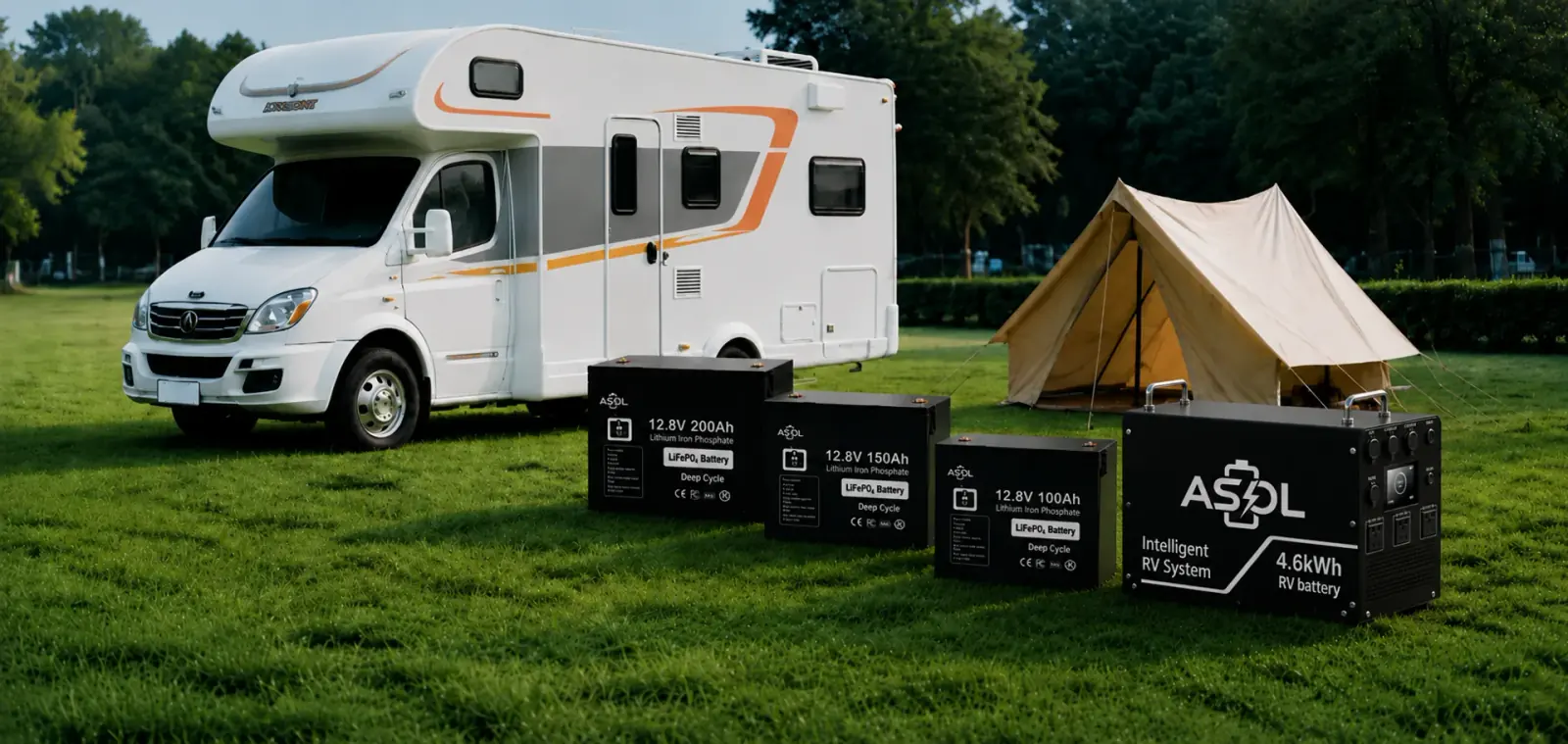
Choosing between a 12V-class and 24V-class LiFePO4 battery system is an important part of RV electrical system design.
The decision should not be based only on battery capacity.
A 12.8V battery may be the most practical choice for an RV already built around 12V electrical equipment, while a 25.6V battery can be worth evaluating for compatible 24V-class systems, especially when inverter power and DC current become more important.
The right choice depends on the complete system:
battery voltage, required energy, inverter power, continuous and peak current, charging equipment, wiring and installation space.
This guide compares 12.8V and 25.6V LiFePO4 battery systems and explains when each configuration may make sense for an RV or caravan project.
12V vs 24V RV Battery System: Quick Comparison
| Consideration | 12.8V LiFePO4 | 25.6V LiFePO4 |
|---|---|---|
| Typical system class | 12V | 24V |
| ASOL capacity options | 100Ah / 200Ah / 300Ah / 400Ah | 100Ah / 200Ah |
| Nominal energy range | 1.28–5.12kWh | 2.56–5.12kWh |
| Current at the same power | Higher | Lower |
| Existing 12V RV loads | Usually easier to integrate | May require DC-DC conversion |
| Higher-power inverter systems | Requires careful current/BMS review | Often worth evaluating |
| Charger requirement | 12V-class compatible charger | 24V-class compatible charger |
| Best fit | Existing 12V systems and flexible capacity selection | Compatible 24V-class or higher-power systems |
Neither system voltage is automatically better.
The more appropriate choice depends on how the RV electrical system is designed.
Why Does RV Battery System Voltage Matter?
Electrical power is related to both voltage and current.
For the same power requirement, increasing system voltage reduces the current required from the battery.
This becomes especially relevant as inverter power increases.
A higher-current battery system requires more attention to:
- cable size
- terminal connections
- fuse and protection design
- BMS continuous-current capability
- heat generated at connection points
A 24V-class system can reduce DC current for the same power level, but this advantage only matters if the rest of the RV electrical system is compatible with 24V operation.
If the vehicle already uses many 12V devices, changing the battery voltage may require additional DC-DC conversion.
So voltage selection should be made at the system level, not by looking at the battery alone.
12.8V LiFePO4 Battery Options for RV Systems
12.8V LiFePO4 batteries are commonly used in RV, camper and caravan electrical systems.
They are particularly practical when the vehicle already uses a 12V electrical architecture.
ASOL currently provides the following 12.8V capacity options:
| Battery Configuration | Nominal Energy |
|---|---|
| 12.8V 100Ah | 1.28kWh |
| 12.8V 200Ah | 2.56kWh |
| 12.8V 300Ah | 3.84kWh |
| 12.8V 400Ah | 5.12kWh |
This allows different RV projects to stay on the same system voltage while selecting different energy capacities.
For example, a compact camper with moderate daily energy use may not require the same battery capacity as a larger RV running a higher-power inverter and more electrical appliances.
However, Ah alone should not determine battery selection.
A higher-capacity battery still needs sufficient BMS discharge capability for the actual inverter and load.
25.6V LiFePO4 Battery Options for 24V-Class RV Systems
For compatible 24V-class RV and caravan systems, ASOL currently provides:
| Battery Configuration | Nominal Energy |
|---|---|
| 25.6V 100Ah | 2.56kWh |
| 25.6V 200Ah | 5.12kWh |
These products provide another option for projects designed around a 24V-class electrical platform.
One important point is that Ah cannot be compared directly across different system voltages.
For example:
- 12.8V 200Ah = approximately 2.56kWh
- 25.6V 100Ah = approximately 2.56kWh
Likewise:
- 12.8V 400Ah = approximately 5.12kWh
- 25.6V 200Ah = approximately 5.12kWh
The stored energy is similar, but the operating voltage is different.
That means the inverter, charger, DC loads and electrical protection must be compatible with the selected voltage.
A 25.6V battery should therefore be considered as part of a 24V-class system design, not as a direct replacement for every 12V RV battery.
Inverter Power Can Influence the 12V vs 24V Decision
One of the most useful questions to ask is:
How much inverter power does the RV need?
As inverter power increases, DC current becomes more important.
For example, a higher-power inverter operating from a 12.8V battery bank may require substantial current from the battery and BMS.
This means the following should be reviewed together:
- continuous inverter power
- surge power
- battery continuous discharge current
- battery peak discharge capability
- BMS rating
- cable and terminal requirements
For a moderate electrical system, 12.8V may remain simple and practical.
For a higher-power system, a 25.6V architecture may be worth evaluating because it can reduce current for the same power demand.
But voltage alone does not solve the problem.
The battery must still have the correct continuous and peak discharge capability.
Compare RV Battery Capacity in kWh, Not Only Ah
Amp-hours are useful when comparing batteries at the same voltage.
When comparing 12V and 24V battery systems, kWh gives a clearer picture of actual stored energy.
For example, comparing:
12.8V 200Ah vs 25.6V 100Ah
based only on Ah could make the 200Ah battery appear to have twice the energy.
It does not.
Both provide approximately 2.56kWh of nominal energy.
This is why RV battery selection should normally start with:
- expected daily energy consumption
- required runtime
- system voltage
- inverter and load requirements
Then the appropriate Ah capacity can be selected. For capacity-specific planning, see our RV battery capacity comparison.
Charging Compatibility Must Be Checked Before Changing Voltage
A battery with the correct capacity can still be unsuitable if the charging system does not match it.
Before selecting a 12.8V or 25.6V LiFePO4 battery, check the RV's:
- AC charger
- solar charge controller
- DC-DC charger
- alternator charging system
- inverter/charger
A charger designed for a 12V battery system should not be assumed to work with a 25.6V battery.
The charging voltage and charging profile must match the battery specification.
This is especially important when converting an existing RV electrical system rather than designing a new system from the beginning.
When Does a 12.8V LiFePO4 System Make Sense?
A 12.8V system is often worth choosing when:
- the RV already uses a 12V electrical architecture
- most onboard DC equipment operates at 12V
- the inverter power is moderate
- simplicity is a priority
- the builder wants multiple capacity choices without changing system voltage
For these applications, 12.8V batteries from 100Ah to 400Ah can provide different energy capacities while keeping the electrical architecture relatively straightforward.
When Does a 25.6V LiFePO4 System Make Sense?
A 25.6V system may be worth evaluating when:
- the RV is already designed around a 24V-class electrical platform
- inverter power is relatively high
- reducing DC current is an important design consideration
- the charger and inverter already support 24V-class operation
- the project requires larger stored energy in a 24V architecture
For example, the ASOL 25.6V 200Ah configuration provides 5.12kWh of nominal energy for compatible 24V-class systems.
But if many onboard loads are still 12V, the system designer should also account for any required DC-DC conversion.
5 Questions to Ask Before Choosing 12V or 24V
Before confirming battery voltage, answer these five questions.
1. What voltage is the existing RV electrical system?
If most equipment is already 12V, keeping a 12V-class battery system may reduce system complexity.
2. What inverter power is required?
Higher inverter power generally means higher DC current at lower battery voltage.
3. How much energy does the RV need?
Calculate daily consumption in Wh or kWh rather than choosing a battery only by Ah.
4. Is the charging system compatible?
Check shore charging, solar charging, alternator charging and inverter/charger settings.
5. What are the installation constraints?
Battery dimensions, terminal location, cable routing and available mounting space can all affect the final battery configuration.
ASOL LiFePO4 Options for RV and Caravan Projects
ASOL currently supports:
12.8V LiFePO4
- 100Ah / 1.28kWh
- 200Ah / 2.56kWh
- 300Ah / 3.84kWh
- 400Ah / 5.12kWh
25.6V LiFePO4
- 100Ah / 2.56kWh
- 200Ah / 5.12kWh
These configurations can be evaluated for compatible RV, caravan and mobile-power projects.
Battery selection can be reviewed according to:
- system voltage
- inverter power
- continuous and peak load
- charger profile
- required energy
- installation dimensions
- terminal requirements
- monitoring functions
- project quantity
OEM and project-specific configurations can also be evaluated according to application requirements.
Frequently Asked Questions
Is a 24V RV battery system better than 12V?
Not necessarily. A 24V-class system can reduce current for the same power level, which may be useful for higher-power applications. A 12V system may be simpler when the RV already uses mainly 12V equipment.
Is 25.6V 100Ah the same capacity as 12.8V 200Ah?
In nominal energy, they are approximately the same at 2.56kWh. However, they operate at different system voltages and require compatible electrical equipment.
Can I replace a 12V RV battery with a 25.6V battery?
Not directly unless the complete electrical system is designed for 24V-class operation. The inverter, charger, DC loads and protection system must all be checked.
Should I compare RV batteries by Ah or kWh?
Ah is useful for batteries at the same voltage. When comparing different system voltages, kWh provides a clearer comparison of stored energy.
What information is needed to select an RV LiFePO4 battery?
Useful information includes system voltage, inverter power, continuous and peak load, required runtime, charging method, installation space, quantity and any required BMS or monitoring functions.
Conclusion
There is no universal answer to whether a 12.8V or 25.6V LiFePO4 battery system is better for an RV.
A 12.8V system can be a practical choice for vehicles already designed around 12V equipment, while a 25.6V system can be worth evaluating for compatible 24V-class and higher-power applications.
The most important step is to evaluate the complete electrical system rather than choosing the battery based only on Ah.
Consider:
system voltage → energy requirement → inverter power → discharge current → charging compatibility → installation space
before confirming the battery configuration.
For RV manufacturers, van builders and project integrators, ASOL can review battery configurations based on the electrical system and project requirements.
Have an RV battery project? Contact ASOL with your system voltage, inverter power, required capacity, installation space and quantity for configuration review.
Discuss Your RV Battery Project
Share your system voltage, inverter power, required capacity, continuous and peak load, charger information, installation space and planned quantity with ASOL for battery configuration review.