Marine Battery Applications
Electric Outboard Propulsion
Battery selection starts with the propulsion system: operating voltage, motor rated power, continuous current, peak current and duration, controller characteristics and required runtime. Motor power alone is not sufficient to approve a battery; controller efficiency, transient loads and protective limits must also be reviewed.
Trolling Motor Battery Systems
For trolling motor brands and marine equipment OEMs, ASOL reviews voltage class, capacity, continuous current, charger compatibility, available installation space, terminals and mounting requirements before proposing a configuration.
Marine Auxiliary & Onboard DC Power
Deep-cycle configurations can also be evaluated for onboard DC equipment and auxiliary loads. These house-power applications are assessed separately from propulsion duty because their load profile and integration requirements are different.
LiFePO4 Battery Configuration References
Standard battery models are shown as configuration references. Final suitability for propulsion applications depends on the motor, controller, discharge requirements, charging profile and approved battery configuration.
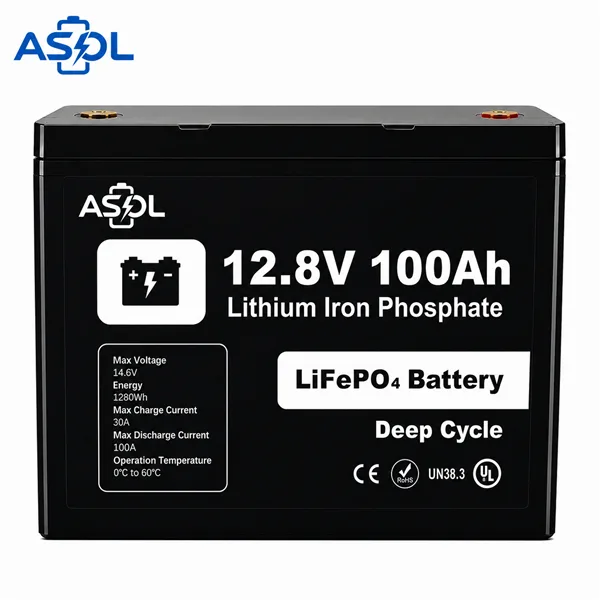
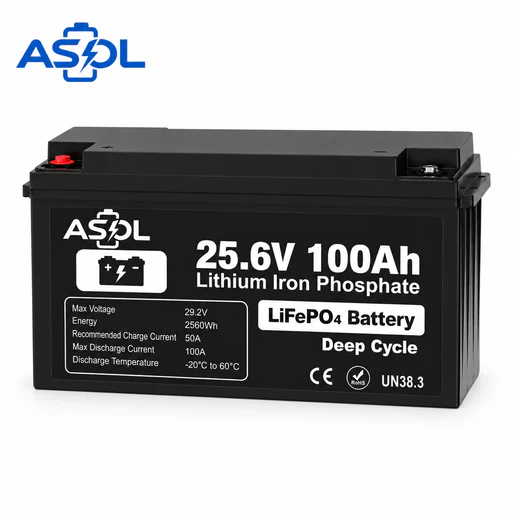
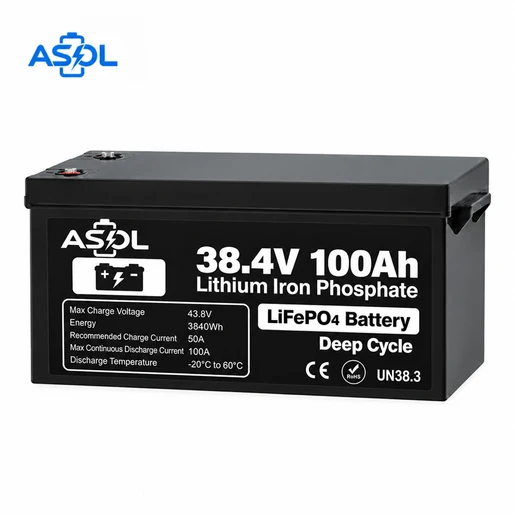
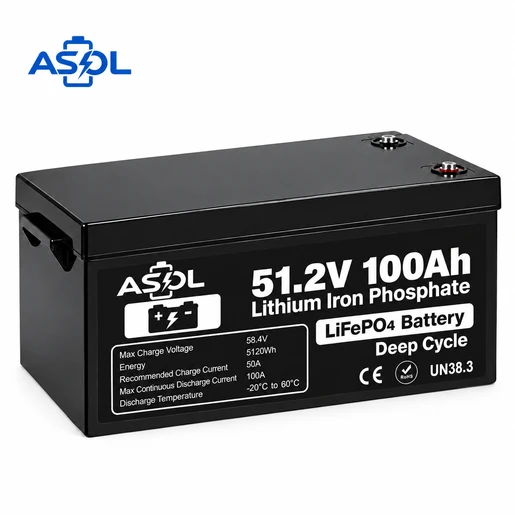
51.2V 100Ah
5.12kWh lead-acid replacement reference; standard 100A continuous and 150A peak discharge; optional CAN/RS485 subject to engineering confirmation.
View SpecificationsThese standard product images and specifications are configuration references only. Suitability for marine propulsion requires review and approval against the final motor, controller, discharge, charging and installation requirements.
Marine OEM Battery Engineering & Customization
Motor & Controller Compatibility
Provide system voltage, rated motor power, continuous and peak current with duration, controller data and target runtime. ASOL uses these inputs to evaluate the electrical configuration; sample validation remains necessary for the final system.
BMS & Discharge Configuration
Continuous current and short-duration peak current are assessed separately. Cell and BMS selection, overcurrent limits and temperature protection are defined for the proposed configuration and must not be inferred from another model.
CAN, RS485 & Bluetooth
Communication can be evaluated where required. Interface availability and protocol compatibility depend on the selected BMS and controller and must be confirmed for the final project.
Marine Enclosure & Waterproof Design
Sealing, terminals, connectors, cable entries and communication ports are reviewed against installation and environmental conditions. An IP67 design target may be evaluated, but it is not a test result or a claim that every ASOL battery is IP67.
Charging & Electrical Integration
Charger output, voltage, current, protection and system connections must match the approved battery. LiFePO4 compatibility with an existing lead-acid charger should never be assumed.
OEM/ODM Battery Configuration
Dimensions, enclosure, terminal layout, connectors, BMS, communication, branding, labeling, documentation and project-specific testing can be evaluated without pre-committing to unverified MOQ, certification or delivery claims.
From Marine Battery Requirements to Approved Production
1. Requirements Review
Share motor voltage and power, continuous and peak current, capacity or runtime, installation dimensions, charging arrangement, communication and estimated quantity.
2. Engineering Configuration Review
ASOL evaluates cells, BMS, electrical architecture, communication and mechanical design, together with applicable testing and documentation needs.
3. Sample Evaluation
The agreed sample is evaluated against electrical, installation, communication and environmental requirements defined for the project.
4. Approved Configuration & Production
Production follows the final confirmed technical specification. Testing, compliance scope and lead time remain project-specific.
Marine LiFePO4 Battery OEM FAQs
How do I select a LiFePO4 battery for an electric outboard motor?
Match the nominal voltage first, then review controller input limits, continuous current, peak current and duration, target runtime, charger and installation conditions. A model should be approved only after the complete system requirements are reviewed.
What motor and controller information is required for battery configuration?
Provide motor voltage and rated power, controller model and limits, continuous and peak current, peak duration, operating profile and expected runtime.
Can ASOL customize the BMS for higher discharge current?
A higher-current BMS can be evaluated against the selected cells, thermal design, conductors, protection strategy and required duty cycle. Availability requires engineering confirmation.
Can marine battery packs support CAN or RS485 communication?
CAN or RS485 can be evaluated for selected configurations. The physical interface and protocol must be confirmed against the controller or system integration specification.
Can ASOL evaluate an IP67 enclosure design?
Yes, an IP67 design target can be evaluated based on enclosure, terminals, connectors, cable entries and installation conditions. The rating should only be claimed after the final configuration completes the required validation.
Can the battery dimensions, terminals and connectors be customized?
These items can be reviewed within the electrical, structural, sealing and manufacturing constraints of the project.
What testing and documentation should be considered for marine OEM projects?
The plan depends on the destination market, application, installation and final configuration. Electrical protection, capacity, communication, environmental and transport requirements should be agreed before sample approval; applicable compliance documents must be confirmed for the selected battery.
Discuss Your Marine Battery Requirements
Send the marine application, motor and controller voltage, rated power, continuous and peak current, required capacity or runtime, installation space, communication, waterproof requirement and estimated quantity.