ASOL supplies lithium polymer pouch cells and evaluates battery-pack solutions for drone and UAV projects. Battery selection depends on the aircraft’s voltage, continuous and peak current, required capacity, weight limit, installation space, connector, charging method and operating environment.
No battery configuration or discharge capability should be assumed to be suitable for an aircraft without reviewing the complete electrical and mechanical requirements.
Table of Contents
- 1. Drone Battery Selection Requirements
- 2. Lithium Polymer Cells and Battery Packs
- 3. Voltage, Current and Discharge Requirements
- 4. Capacity, Weight and Installation Space
- 5. Connectors, Wiring and Protection
- 6. Reference Battery Solution
- 7. OEM/ODM Project Evaluation
- 8. Quality, Testing and Documentation
- 9. Frequently Asked Questions
- 10. Contact ASOL Battery
1. Drone Battery Selection Requirements
A drone battery must support the aircraft’s complete power profile, including normal flight current, take-off demand, acceleration, climbing, payload changes and short-duration peak current.
Battery capacity alone does not determine compatibility. Before selecting a battery, confirm:
- Required nominal voltage and cell count
- Continuous operating current
- Maximum and short-duration peak current
- Required capacity and target flight profile
- Maximum battery weight
- Maximum permitted dimensions
- Connector and wire requirements
- Charging voltage and charging method
- Balance-charging requirements
- Operating and charging temperature
- Aircraft type and payload
- Estimated order quantity
- Delivery destination
Where available, customers should provide motor, ESC, propeller, payload and existing battery specifications to support current and compatibility evaluation.
2. Lithium Polymer Cells and Battery Packs
Lithium Polymer Pouch Cells
Individual lithium polymer pouch cells generally have a nominal voltage of 3.7V, depending on the selected model. Available dimensions, capacity, current capability and terminal configuration depend on the specific cell specification. Explore ASOL’s lithium polymer battery manufacturing capabilities and lithium polymer battery range.
Protected Single-Cell Assemblies
For suitable low-voltage applications, a pouch cell may be assembled with an appropriate PCM, NTC, wires, connector and insulation. Component selection depends on the charging method, load current and equipment requirements.
Multi-Cell Drone Battery Packs
Multi-cell battery packs may be evaluated when a drone or UAV requires a higher operating voltage. Cell count, series and parallel configuration, interconnection, PCM or BMS, balance lead, wiring, connector and mechanical support must be confirmed according to the project.
Not every pouch cell is suitable for a drone application or high-discharge operation. Current capability must be confirmed from the selected cell specification and project requirements.
3. Voltage, Current and Discharge Requirements
The battery voltage must match the aircraft’s motor, ESC and power-system requirements. Continuous and peak current must be evaluated separately because take-off, climbing, acceleration and payload changes may create short-duration current demand above the normal flight current.
| Item | Information required |
|---|---|
| Nominal voltage | Required battery voltage or cell count |
| Continuous current | Normal operating current during flight |
| Peak current | Maximum current and permitted duration |
| Capacity | Required energy and flight profile |
| Charging | Charger voltage, current and balance-charging method |
| Protection | PCM, BMS, fuse or aircraft-side protection requirements |
C-rate should not be used without confirming the corresponding current in amperes. Required current can be estimated from capacity and C-rate, but the selected cell and complete battery pack must actually support that current under the applicable conditions.
4. Capacity, Weight and Installation Space
Increasing capacity may increase available energy, but it can also increase battery dimensions and weight. The final battery choice requires a balance between energy requirement, aircraft payload, center of gravity, available installation space and required current capability.
Please confirm:
- Maximum battery weight
- Maximum length, width and height
- Battery mounting method
- Center-of-gravity requirements
- Cable-routing space
- Permitted dimensional tolerances
- Required mechanical support
- Vibration and impact conditions
ASOL should not estimate or guarantee flight time without the aircraft’s complete power-consumption and operating data.
5. Connectors, Wiring and Protection
Connector, wire and protection requirements depend on the battery current, voltage, charger and aircraft design. Depending on technical feasibility, ASOL can evaluate:
- Connector model
- Main power-wire length and gauge
- Balance lead requirements
- PCM or BMS requirements
- Temperature sensing
- Fuse and insulation requirements
- Labels and polarity identification
- Mechanical wrapping or enclosure requirements
XT60, XT90 or other connector types may be considered when compatible with the confirmed current and project requirements. No connector should be assumed to be available or suitable without evaluation. See the BMS selection guide for related protection considerations.
6. Reference Battery Solution
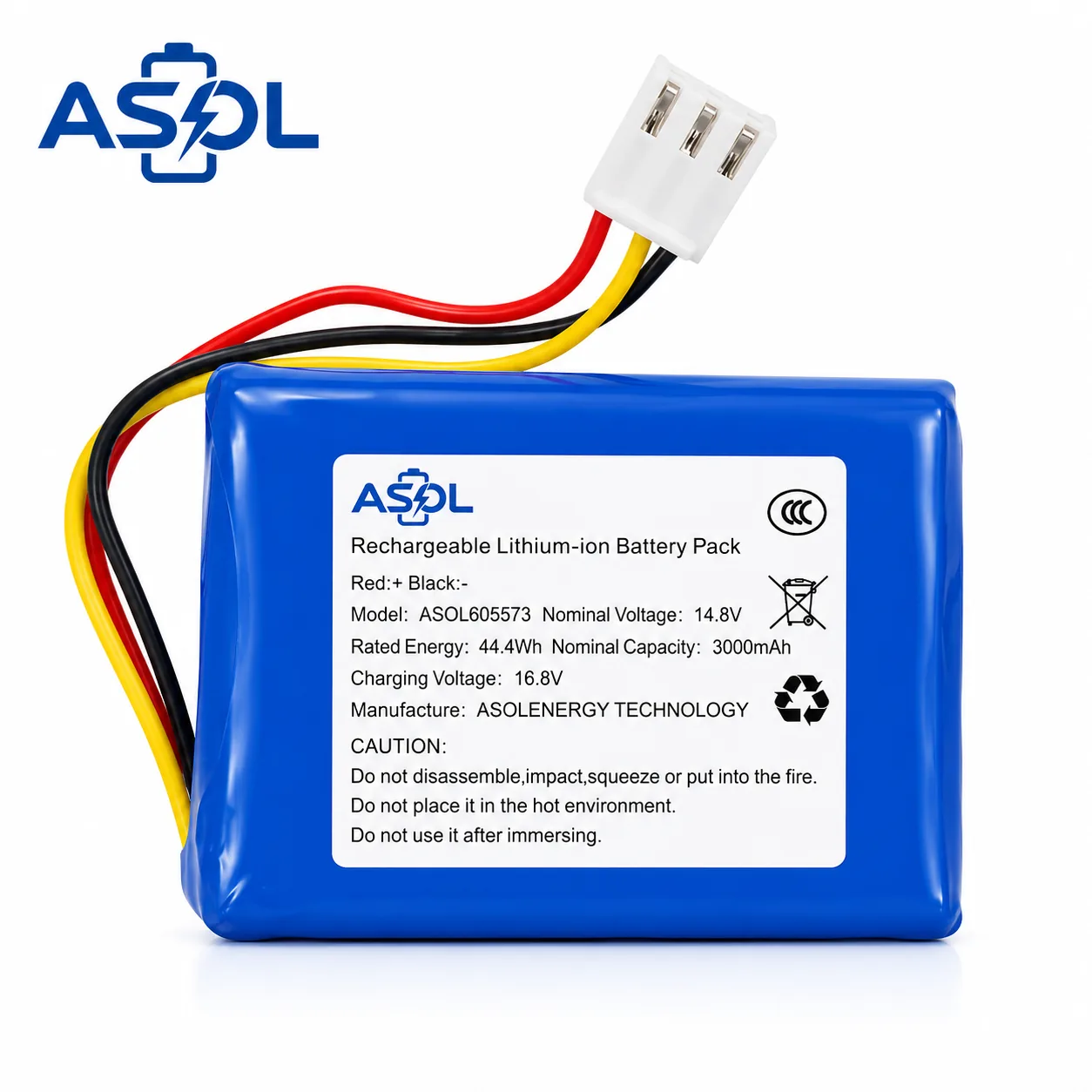
ASOL 605573-4S 14.8V 3000mAh Lithium Polymer Battery Pack
- Nominal voltage: 14.8V
- Capacity: 3000mAh
- Energy: 44.4Wh
- Configuration: 4S1P lithium polymer pouch cells
This battery pack is shown as a reference configuration. Suitability for a drone, UAV, robotics or other mobile application depends on the required continuous and peak current, connector, charging method, installation space, weight limit and operating conditions.
View reference battery pack7. OEM/ODM Project Evaluation
ASOL evaluates lithium polymer battery projects for drone and UAV manufacturers, equipment developers and B2B buyers. Available cell models, battery configurations and customization options depend on the confirmed electrical, mechanical and order requirements. For broader project context, see custom lithium battery pack manufacturing and robotics and utility equipment battery solutions.
- Aircraft and power-system requirement review
- Voltage, current and capacity evaluation
- Available cell and battery configuration review
- Connector, wiring and protection evaluation
- Preliminary specification and quotation
- Sample feasibility and arrangement, when applicable
- Customer testing and specification confirmation
- Production arrangement
Samples may be evaluated for lithium polymer battery projects according to the selected cell, battery configuration, specifications, quantity and project feasibility. Sample specifications, cost and lead time are confirmed separately, and sample freight is paid by the customer.
8. Quality, Testing and Documentation
Quality checks and documentation requirements depend on the selected cell or battery pack, configuration, order and destination market. Project-specific checks may include appearance and dimensional inspection, voltage and internal-resistance checks, capacity testing, protection-function checks and final battery inspection, as applicable.
Available certifications, transport test reports and compliance documents must be confirmed for the specific cell or battery configuration and destination before ordering. Do not assume that every battery carries the same certification set.
UAV Applications
Lithium polymer battery solutions may be evaluated for:
- Compact drone and UAV projects
- Inspection and mapping equipment
- Aerial imaging platforms
- Mobile robotics and unmanned equipment
- Project-specific portable equipment
Suitability depends on the required voltage, continuous and peak current, capacity, weight, dimensions and operating environment.
9. Frequently Asked Questions
Can ASOL provide lithium polymer batteries for drone and UAV projects?
ASOL can evaluate lithium polymer pouch cells and battery packs for suitable drone and UAV projects. Feasibility depends on voltage, continuous and peak current, capacity, weight, dimensions, connector and operating requirements.
What information is required to select a drone battery?
Please provide the aircraft type, voltage or cell count, continuous and peak current, capacity, maximum weight, maximum dimensions, connector, charging method, payload, quantity and destination.
Does a higher-capacity battery always provide longer flight time?
Not necessarily. A higher-capacity battery may also increase weight and affect aircraft performance. Flight time depends on the complete aircraft, load, battery, operating conditions and flight profile.
What discharge rate can ASOL provide?
Discharge capability depends on the selected cell and battery configuration. Please provide the required continuous and peak current in amperes, the peak-current duration and the required capacity for evaluation.
Can ASOL provide XT60, XT90 or a balance connector?
Connector and balance-lead options may be evaluated according to the confirmed voltage, current, charging method and project requirements. Availability and suitability must be confirmed for the selected battery.
Are samples available?
Samples may be evaluated for lithium polymer battery projects according to the selected cell, configuration, specifications, quantity and project feasibility. Sample specifications, cost and lead time are confirmed separately, and sample freight is paid by the customer.
What certifications are available?
Available certifications, transport test reports and compliance documents depend on the selected cell or battery configuration and destination market. Applicable requirements must be confirmed before ordering.
How are MOQ, price and lead time confirmed?
MOQ, pricing and lead time depend on the selected cell, battery configuration, customization requirements, quantity and delivery destination. They are confirmed after the project requirements have been reviewed.
How do I request a quotation?
Email info@asolbattery.com or WhatsApp +86 15779858703 with your aircraft type, voltage, capacity, continuous and peak current, weight limit, dimensions, connector and quantity. We reply within 24 hours on working days.
10. Contact ASOL Battery
Discuss Your Drone or UAV Battery Requirements
Share your aircraft type, required voltage, capacity, continuous and peak current, maximum weight, maximum dimensions, connector, charging method, quantity and destination with ASOL for project evaluation.
Email: info@asolbattery.com
WhatsApp: +86 157 7985 8703
We reply within 24 hours on working days.