Table of Contents
- 1. What Battery Requirements Should Lighting Manufacturers Confirm?
- 2. Recommended Battery Configurations for Wireless Stage Lighting
- 3. Why Use Lithium Polymer Batteries in Wireless Lighting Fixtures?
- 4. Battery Runtime Depends on Power Consumption
- 5. Typical Applications
- 6. How ASOL Supports Custom Stage-Lighting Battery Projects
- 7. Information to Include in Your Inquiry
- 8. Frequently Asked Questions
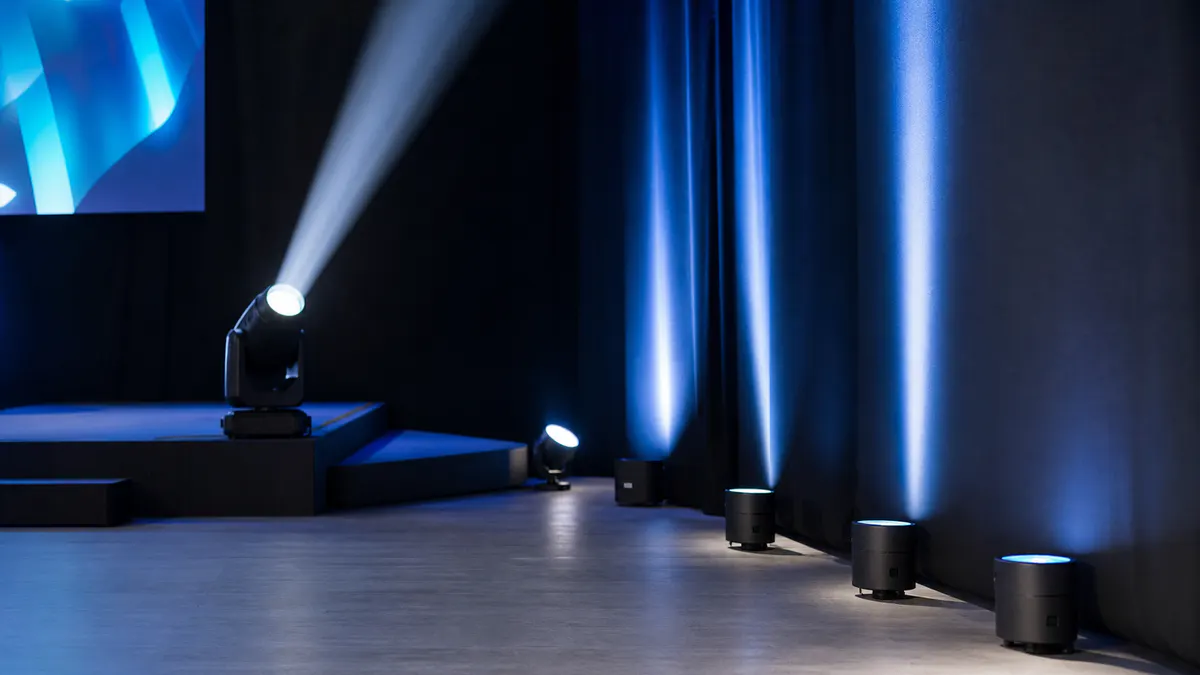
Wireless LED PAR lights, battery-powered uplights and portable event lights need an internal power source that balances runtime, weight, installation space, stable output and charging safety. For lighting manufacturers, this makes the battery pack part of the fixture design rather than a generic accessory.
There is no single battery specification suitable for every wireless stage light. Operating voltage, fixture power, internal space and target runtime vary by project, so a custom battery pack for wireless stage lighting should be evaluated against the actual fixture requirements.
1. What Battery Requirements Should Lighting Manufacturers Confirm?
Before developing a rechargeable battery pack for stage lights, the product and purchasing team should confirm the electrical, mechanical and production inputs together. Capacity alone does not determine whether a pack is suitable; voltage and power demand are equally important.
- Fixture operating voltage
- Rated power and maximum power consumption
- Required operating time
- Available battery-compartment dimensions
- Continuous and peak discharge current
- Charging voltage and charging method
- Connector type, wire length and polarity
- Protection-circuit requirements
- Operating temperature
- Expected order quantity
A higher mAh value can add energy, but it does not correct an incompatible voltage, an undersized discharge path or a pack that cannot fit in the fixture housing. A drawing, existing battery label or photos of the battery compartment are useful starting points for an engineering review.
It is also useful to identify how the fixture behaves during start-up, wireless control and full-brightness operation. LED drivers, display modules and wireless receivers can create different load conditions from a steady white-light test. The pack, protection circuit and wire gauge should be reviewed against the expected operating profile rather than only a nominal wattage printed on the fixture.
2. Recommended Battery Configurations for Wireless Stage Lighting
These configurations are preliminary references for custom projects, not fixed in-stock ASOL products. Final voltage, capacity, dimensions, discharge current, protection circuit and connector must be confirmed according to the lighting fixture requirements.
| Reference configuration | Energy | Suggested project direction |
|---|---|---|
| 7.4V 7000mAh lithium polymer battery pack | 51.8Wh | Compact wireless LED PAR lights, decorative uplights and stage accent lights |
| 11.1V 8000mAh lithium polymer battery pack | 88.8Wh | Medium-power wireless PAR lights and professional battery-powered uplights |
| 14.8V 8000mAh lithium polymer battery pack | 118.4Wh | Higher-power wireless stage-lighting fixtures requiring greater energy capacity |
The 11.1V 8000mAh lithium polymer battery is a useful mid-voltage and mid-capacity reference for many lighting projects, but it is not a universal choice. The fixture’s input range, charging design, average load and available installation space still determine the final pack configuration.
3. Why Use Lithium Polymer Batteries in Wireless Lighting Fixtures?
A lithium polymer battery for stage lights can be considered when the fixture has limited or non-standard installation space. Pouch-cell pack design can support a range of practical battery shapes while retaining the electrical features needed by the fixture.
- Flexible pack dimensions for limited installation space
- High energy density for a compact fixture design
- Lightweight battery-pack construction
- Custom voltage and capacity configurations
- Custom connectors, wiring and protection circuits
For available cell and pack formats, see ASOL’s lithium polymer battery category. A custom LiPo battery pack for lighting equipment should then be matched to the fixture enclosure and electrical design.
Mechanical integration matters as much as chemistry selection. The final layout may need allowance for a protection board, insulating materials, wire routing, connector access and normal assembly tolerances. Confirming those details early helps the lighting team avoid a pack that is electrically suitable but difficult to install or service inside the finished fixture.
4. Battery Runtime Depends on Power Consumption
It is not reliable to promise fixture runtime from mAh alone. Energy and average fixture power provide a more useful first estimate:
Estimated runtime (hours) = usable battery energy (Wh) ÷ average fixture power (W)
Actual operating time can vary with brightness setting, color combination, control mode, conversion efficiency, discharge cut-off voltage and working temperature. For that reason, the reference configurations above are not presented with fixed runtime hours. The right process is to assess the power profile of the intended wireless LED light, then define a practical energy target and engineering margin.
5. Typical Applications
Custom rechargeable battery packs for stage lights are commonly evaluated for internal installation in:
- Wireless LED PAR lights
- Battery-powered uplights
- Stage accent lights
- Portable event lighting
- Touring lighting fixtures
- Wireless architectural lighting
The focus is the battery module built into the lighting fixture, including its electrical interface, protection requirements and mechanical fit.
6. How ASOL Supports Custom Stage-Lighting Battery Projects
ASOL supports B2B battery-development discussions for lighting manufacturers, stage-equipment OEMs and product teams. The normal workflow begins with the fixture voltage, power demand and available space. ASOL can then evaluate the battery configuration and confirm the capacity, protection circuit, wiring and connector requirements with the project team.
Prototype or sample availability is evaluated according to the battery specification and project requirements. Sample freight is paid by the customer. Mass-production requirements are confirmed after technical validation. For a broader overview of custom-pack development, see how to customize a battery pack for your product.
7. Information to Include in Your Inquiry
To evaluate an OEM battery pack for stage lights efficiently, please include:
- Lighting fixture type
- Operating voltage
- Rated and maximum power
- Required runtime
- Maximum battery dimensions
- Connector type
- Charging method
- Estimated order quantity
- Existing battery label, specification or photos if available
These details help distinguish a practical custom battery module from a preliminary capacity request and allow the pack design to be reviewed against the fixture’s real operating conditions.
If the final specification is still being developed, send the information that is available and identify the open points. Fixture drawings, wiring diagrams and charger information can help clarify the voltage range, connector interface and available pack envelope before a final recommendation is made.
8. Frequently Asked Questions
What battery capacity is suitable for a wireless LED PAR light?
There is no single capacity for every fixture. The suitable capacity depends on operating voltage, fixture power and the target runtime, along with the available battery space.
Is an 8000mAh battery suitable for every stage light?
No. mAh is only one capacity measure. Voltage, Wh, discharge current, dimensions and connector requirements must also match the fixture.
Can the battery voltage and dimensions be customized?
They can be evaluated and customized according to the project requirements. The final configuration is confirmed after technical review of the fixture and charging design.
What information is required to develop a custom stage-lighting battery pack?
Please provide working voltage, power, available dimensions, runtime target, charging method, connector requirements and estimated purchase quantity.
Can ASOL provide samples for custom lithium polymer battery projects?
Sample or prototype availability is evaluated according to the battery specification and project requirements. Sample freight is paid by the customer.
For existing cell and battery-pack options, browse ASOL’s Cylindrical Lithium Batteries and Lithium Polymer Batteries. If a model is not an exact fit, send the fixture voltage, required runtime, available space and connector requirements for evaluation.
Explore Stage Lighting & Live Event Battery Solutions for professional mobile ESS and stage-lighting, film-production or live-event project guidance.
Planning a wireless stage lighting project?
Send us the fixture voltage, power consumption, available battery dimensions, required runtime, charging method, connector type and estimated order quantity. ASOL will evaluate a custom lithium polymer battery solution for your project.
Get a Quote