Battery Knowledge
Battery energy storage systems generate heat whenever cells charge and discharge. Managing that heat is a practical engineering requirement that affects cell temperature consistency, operating stability, enclosure design, installation requirements and long-term system reliability.
For commercial and industrial buyers, the choice between an air-cooled and a liquid-cooled battery energy storage system should therefore begin with the project rather than a generic product preference. Neither method is universally superior. A well-designed air-cooled system can be a sensible fit for many projects, while a liquid-cooled system can be appropriate where thermal demand, system density or operating conditions call for a different approach.
This guide compares both options for energy integrators, EPC contractors, distributors and project developers evaluating C&I battery storage. It also explains why a stated capacity, including a 100kW/215kWh requirement, is not enough by itself to determine the right cooling method.
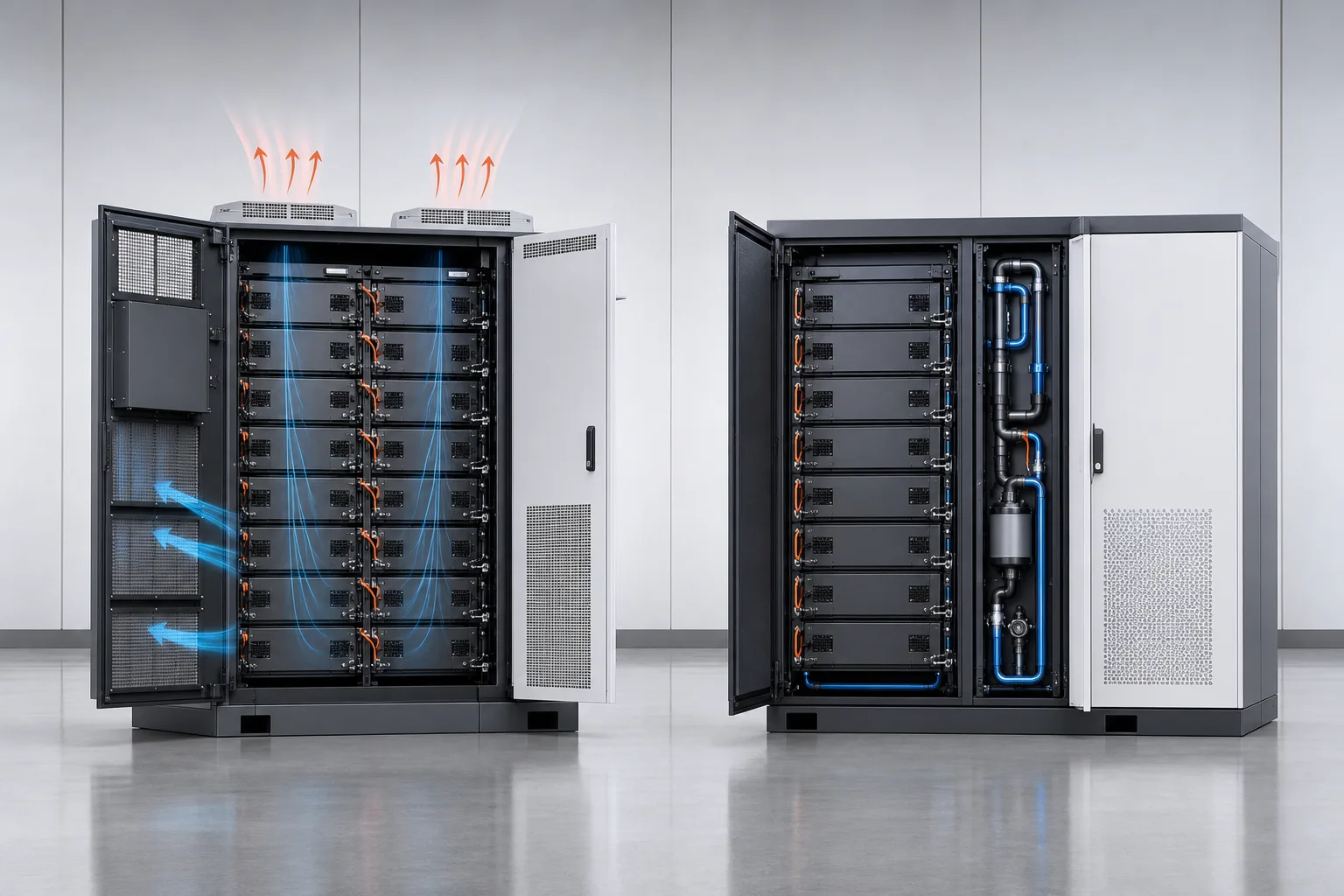
Table of Contents
- 1. Why Thermal Management Matters in Battery Energy Storage Systems
- 2. What Is an Air-Cooled Battery Energy Storage System?
- 3. What Is a Liquid-Cooled Battery Energy Storage System?
- 4. Air-Cooled vs. Liquid-Cooled Energy Storage Systems
- 5. When Should You Choose an Air-Cooled System?
- 6. When Should You Choose a Liquid-Cooled System?
- 7. Which Cooling Method Is Suitable for a 100kW/215kWh Energy Storage System?
- 8. Commercial and Industrial Energy Storage Applications
- 9. Information Required Before System Selection
- 10. Other Factors to Consider Beyond Cooling
- 11. Frequently Asked Questions
- 12. Conclusion
1. Why Thermal Management Matters in Battery Energy Storage Systems
Thermal management is the system of components and controls used to keep battery equipment within its intended operating temperature range. In an industrial battery energy storage system, it connects the battery modules, enclosure, sensors, BMS, HVAC or liquid loop, and the surrounding installation environment. The goal is not simply to make the cabinet feel cool. It is to manage heat in a controlled, repeatable way across changing load and ambient conditions.
- Control the working temperature of battery cells and associated equipment.
- Reduce unnecessary temperature differences between cells and modules.
- Support stable charging and discharging under the project’s defined operating profile.
- Improve the consistency and reliability of day-to-day system operation.
- Adapt the enclosure and controls to indoor, outdoor, dusty, hot, cold or space-constrained installation environments.
Thermal management must also be evaluated with the electrical design. Power demand, expected duration, charge and discharge frequency, inverter behaviour, cable routing and auxiliary consumption all shape the real duty placed on the system. For that reason, cooling is one part of system selection alongside LiFePO4 configuration, BMS functions, PCS or inverter compatibility, EMS controls and safety protection.
2. What Is an Air-Cooled Battery Energy Storage System?
An air-cooled energy storage system removes heat by moving conditioned air through or around battery racks and cabinet compartments. Depending on the design, it may use fans, ducts, air paths, filters, vents and air-conditioning equipment. Sensors and controls monitor conditions and adjust fan or HVAC operation to help maintain the desired thermal environment.
Advantages of Air Cooling
- The system structure is relatively straightforward and readily understood by many service teams.
- Initial investment is often lower because the thermal system usually has fewer specialized components.
- Routine maintenance practices such as checking fans, filters, ducts and HVAC equipment are familiar.
- It can be a practical choice for commercial and industrial energy storage projects with moderate thermal-management requirements.
For a site with adequate space, accessible service routes and an operating profile that does not impose unusually high thermal demand, air cooling can provide a balanced engineering and commercial solution. In such cases, selection should focus on the quality of airflow design and the ability to keep the air path clean and unobstructed throughout operation.
Limitations of Air Cooling
- Air has a comparatively limited ability to transfer heat, so the design must manage airflow carefully.
- Temperature uniformity can depend more heavily on duct design, rack arrangement and airflow balance.
- The installation must allow space for air circulation, return paths and service access.
- Fans, filters and air paths need regular inspection and cleaning, especially in dusty or polluted environments.
3. What Is a Liquid-Cooled Battery Energy Storage System?
A liquid-cooled energy storage system transfers heat through a controlled coolant loop rather than relying only on air movement near the battery modules. The arrangement may include coolant, pipes or hoses, pumps, cold plates, manifolds, a heat exchanger or chiller, valves, sensors and thermal-control equipment. Heat is collected from the system and moved through the loop to be rejected or managed elsewhere.
Advantages of Liquid Cooling
- It can provide higher heat-transfer capability than an air-only approach.
- It can support more even temperature control when the battery and cooling loop are designed as an integrated system.
- It can enable more compact system layouts where the project has limited installation space.
- It is often considered for higher energy density, more frequent cycling or projects that require more closely managed thermal conditions.
For example, an EPC team may consider liquid cooling when a C&I battery storage system must fit into a constrained technical area, operate frequently, or be deployed in a location with demanding ambient temperatures. The value is not that liquid cooling is automatically preferable; it is that its thermal architecture may match those particular constraints more effectively.
Limitations of Liquid Cooling
- The thermal system is more complex and normally involves more components than an air-cooled solution.
- Initial investment is commonly higher because of pumps, piping, thermal equipment and controls.
- Service plans need to cover coolant condition, pumps, pipework, fittings, seals and heat-exchange equipment.
- Installation and maintenance teams need the capability to inspect and service the cooling loop correctly.
Liquid cooling also changes the maintenance conversation. A project team must define who will inspect the system, how fault conditions will be monitored, what access is available for service and how replacement or replenishment materials will be handled. These are operational considerations that should be discussed before procurement, not after commissioning.
4. Air-Cooled vs. Liquid-Cooled Energy Storage Systems
The following comparison summarizes the usual decision factors. It is a planning tool rather than a performance guarantee. Final results depend on system design, operating environment, controls, installation quality and maintenance.
| Comparison item | Air-cooled system | Liquid-cooled system |
|---|---|---|
| Cooling medium | Conditioned and circulated air | Coolant circulated through a thermal loop |
| Heat-transfer capability | Generally lower; performance relies on air volume, air paths and HVAC design | Generally higher; heat can be transferred through a controlled liquid loop |
| Temperature uniformity | Depends strongly on cabinet layout, ducting and airflow balance | Can support more direct and uniform heat removal when designed correctly |
| System complexity | Relatively straightforward, with fans, filters, ducts and HVAC components | More components, potentially including coolant, pumps, pipes, cold plates and controls |
| Installation space | Requires room for ventilation, return paths and service access | Can support compact layouts, while still requiring service access for the cooling loop |
| Initial investment | Often lower for comparable project scopes | Often higher because of additional thermal-management equipment |
| Maintenance requirements | Fan, filter, air-path and HVAC inspection are important | Coolant, pumps, pipes, fittings, seals and heat-exchange equipment need inspection |
| Suitable operating conditions | Moderate thermal demand, suitable space and service-friendly installations | Higher density, frequent operation, constrained space or tighter thermal-control requirements |
5. When Should You Choose an Air-Cooled System?
An air-cooled system is often worth considering when the project has moderate thermal-management needs and the design can provide sufficient space for ventilation and service. It may also fit buyers who prioritize a relatively simple system structure and familiar maintenance practices.
- The thermal demand is moderate for the intended duty cycle.
- Charge and discharge intensity is relatively moderate rather than continuously demanding.
- There is adequate room for ventilation, air return paths and technician access.
- The project values a simpler thermal architecture and maintenance convenience.
- Initial investment is a significant selection factor.
These conditions should be verified through project data, not assumed. In particular, an apparently moderate application can become more demanding if the system is installed in a high-ambient-temperature location, a poorly ventilated room or an enclosure exposed to dust. The system supplier and project team should review operating assumptions together before fixing the cooling architecture.
6. When Should You Choose a Liquid-Cooled System?
A liquid-cooled system may be considered when the project needs a more compact layout, faces higher operating intensity or requires closer temperature control. It can be particularly relevant when physical space is restricted or when the expected profile involves frequent charging and discharging.
- The required system has relatively high energy density or a compact footprint.
- Installation space is limited and a more compact layout is valuable.
- The planned operating profile involves frequent charge and discharge activity.
- Ambient conditions are hot or otherwise challenging for air-based thermal management.
- The project calls for more controlled and uniform temperature management.
The decision should include the practical ability to maintain a liquid loop. A technically suitable solution can still be a poor operational fit if the site has no trained service resource, no access for inspection or no clear procedure for responding to pump, coolant or leak-related alarms. Procurement teams should evaluate the total service model alongside the equipment specification.
7. Which Cooling Method Is Suitable for a 100kW/215kWh Energy Storage System?
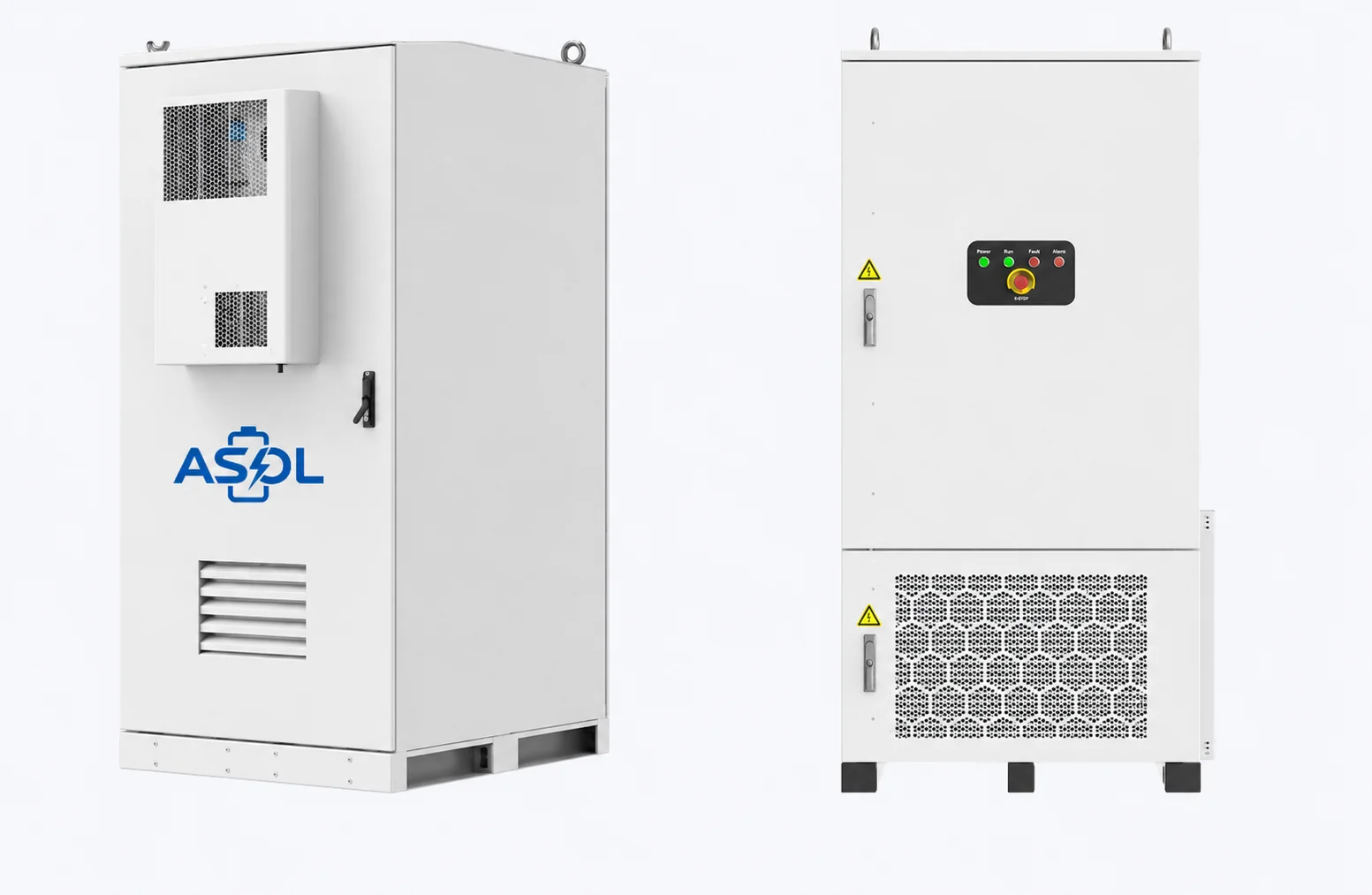
A 100kW/215kWh energy storage system is a common reference point for commercial and industrial energy storage discussions, but those two numbers should not be used to select cooling by themselves. A 215kWh battery energy storage system used for limited peak shaving under moderate ambient conditions has a different thermal profile from a similarly rated system that cycles frequently, supports EV charging or operates in a hot, space-constrained installation.
Both air-cooled and liquid-cooled approaches can be evaluated for this project size. The appropriate choice depends on the information below:
- Operating profile: expected load, duration, scheduling and periods of repeated activity.
- Ambient temperature: normal seasonal conditions, peak temperature and whether the equipment is indoors or outdoors.
- Installation space: room layout, ventilation paths, enclosure clearances and service access.
- Charge and discharge frequency: how often the system will cycle and whether duty is concentrated at particular times.
- Maintenance conditions: available personnel, inspection procedures, cleaning access and spare-part strategy.
- Project budget: the initial equipment scope as well as the maintenance model over the operating period.
ASOL provides air-cooled and liquid-cooled configurations for commercial and industrial energy storage projects, including 100kW/215kWh system requirements. Final system selection depends on the required power, storage capacity, system voltage, operating profile, installation environment, communication requirements and compatibility with the PCS or inverter.
8. Commercial and Industrial Energy Storage Applications
Commercial and industrial energy storage systems are deployed for different operating objectives, and these objectives influence thermal requirements. The same system may be asked to support different power levels, durations and schedules depending on the site.
Peak shaving and load management
In peak-shaving projects, storage may discharge during periods of high facility demand and recharge during lower-demand periods. The operating schedule, peak duration and repetition determine the thermal load more usefully than capacity alone.
Solar energy integration
Solar integration can introduce a daily charging pattern that varies with season, irradiance and facility load. Cooling selection should consider the energy-management strategy, available installation area and local ambient conditions.
Commercial and industrial backup power
Backup applications may have a different duty profile from daily-cycling systems. Teams should assess standby conditions, expected discharge events, critical-load requirements and the enclosure environment rather than assuming that backup use has no thermal-management implications.
EV charging infrastructure
Where storage supports EV charging, load patterns can be concentrated and variable. The design review should cover charging demand, transformer and PCS configuration, expected utilization and the location available for the energy storage equipment.
Microgrid and off-grid projects
Microgrid and off-grid projects combine storage with solar, generators, variable loads and site-specific environmental conditions. These projects benefit from early coordination between the battery system, controls, generation sources and maintenance plan. For broader use cases, see ASOL’s energy storage and outdoor power applications.
9. Information Required Before System Selection
Clear input data helps a supplier recommend a commercial and industrial energy storage system that can be engineered for the actual site. It also reduces revisions during quotation, installation and commissioning. Before requesting a proposal, prepare as much of the following information as possible:
- Project application and the business or operational objective.
- Required power in kW or MW.
- Required capacity in kWh or MWh.
- Grid voltage and frequency.
- Daily operating profile, including expected peak periods and duration.
- Expected charge and discharge frequency.
- Installation environment, such as indoor or outdoor location and exposure conditions.
- Ambient temperature range and any site-specific thermal constraints.
- Available installation space, clearance requirements and access routes.
- Solar, inverter, PCS or generator information where applicable.
- Communication requirements, including relevant protocols and monitoring interfaces.
- Local certification, permitting and grid-interconnection requirements.
This information supports a more useful technical dialogue. It allows the cooling method to be evaluated alongside battery configuration, BMS communication, PCS compatibility and protection requirements. It is also important for deciding whether a standard platform or custom industrial battery solutions is the more appropriate starting point.
10. Other Factors to Consider Beyond Cooling
Cooling is important, but it is not the complete specification for an industrial battery energy storage system. A project should examine the interfaces between all major components and the responsibilities for integration, commissioning and ongoing support.
- LiFePO4 battery configuration: module arrangement, voltage architecture and capacity sizing must fit the application.
- BMS: monitoring, protection, balancing and communication functions should match the battery design and operating strategy.
- PCS or inverter compatibility: power conversion equipment must be compatible with the system voltage, power requirements and control approach.
- EMS: the energy-management strategy should reflect tariffs, solar generation, backup priorities or load-management goals.
- Electrical protection: protection devices, isolation, cabling and site electrical design need coordinated engineering.
- Fire detection and protection: requirements should be evaluated for the local site, installation method and applicable regulations.
- Communication protocols: interfaces such as CAN, RS485 or project-specific monitoring requirements should be confirmed early.
- Enclosure protection: ingress protection, corrosion exposure, ventilation and service access need to suit the environment.
- Installation and commissioning: logistics, foundations, clearances, cabling and test procedures affect the finished project.
- Remote monitoring and maintenance: alarm handling, data access and service responsibilities should be agreed before handover.
These factors reinforce the central point: cooling technology should be chosen as part of the whole system. A project that matches its thermal architecture to the site, electrical design and service capability is better positioned for orderly commissioning and sustainable operation.
11. Frequently Asked Questions
Is liquid cooling always better than air cooling?
No. Liquid cooling offers a different thermal-management approach, but it is not automatically the better choice. The appropriate option depends on the operating profile, ambient conditions, space, maintenance capability, system design and project budget.
Is air cooling suitable for industrial energy storage?
Yes. An air-cooled energy storage system can be suitable for industrial projects with moderate thermal demand, appropriate installation space and an operating profile that can be supported by its ventilation and HVAC design.
Does liquid cooling automatically extend battery life?
No. Battery service life depends on the overall battery design, cell selection, temperature management, operating conditions, BMS strategy, charging and discharging profile, and maintenance. Liquid cooling alone does not determine battery life.
Which cooling system requires more maintenance?
Liquid cooling usually introduces more components to inspect, such as coolant, pumps, pipework, seals and heat-exchange equipment. Air-cooled systems also need maintenance, including cleaning filters, fans and air paths. Actual requirements depend on the specific system design and site conditions.
Can the cooling method be selected based only on storage capacity?
No. Storage capacity is only one input. A proper selection should also consider power, duty cycle, ambient temperature, available space, installation environment, maintenance conditions, controls and the project budget.
What information is required for an energy storage quotation?
A useful quotation request includes the application, required power and capacity, grid voltage and frequency, operating profile, cycling frequency, installation environment, ambient temperature, available space, energy sources, communication requirements and local certification requirements.
12. Conclusion
Air-cooled battery energy storage systems can be a suitable option for projects with a relatively simple thermal architecture, moderate operating conditions, adequate ventilation space and a preference for familiar maintenance activities. Liquid-cooled systems can be suitable for higher-density, frequently operated or more thermally demanding projects, especially where compact layout or closer temperature control is important.
The selection should not be made from capacity alone. A sound decision combines power and storage requirements with the operating profile, ambient temperature, installation space, charge and discharge frequency, maintenance conditions, electrical interfaces and project budget. That is the practical way to determine whether an air-cooled or liquid-cooled battery energy storage system fits the project.
Explore Industrial Energy Storage Systems for ASOL’s commercial and industrial ESS reference configurations and project inquiry path.