Outdoor equipment often needs to remain operational during unexpected power outages. For access control systems, security cameras, communication terminals, outdoor lighting and industrial monitoring equipment, a power interruption can affect security, operational continuity and equipment availability.
Selecting a backup battery involves more than choosing a suitable voltage and capacity. The complete power system must be designed around the equipment's electrical requirements, backup duration, power switching method and outdoor operating conditions.
This guide explains the key engineering and procurement considerations when developing a lithium battery backup power system for outdoor equipment.
1. Understand the Equipment's Power Requirements
Before selecting a battery, identify how the equipment operates under both normal and backup power conditions.
Key electrical requirements include:
- Equipment operating voltage: 12V DC, 24V DC, 48V DC or AC.
- Average operating power.
- Maximum power consumption and start-up current.
- Required backup duration.
- Acceptable power interruption during switching.
- Available charging power source.
An access control system, for example, may include a controller, identification terminal, communication module and electronic lock.
The battery system must support the combined load, including temporary increases in power consumption during equipment activation.
2. Calculate the Required Battery Capacity
Battery capacity should be calculated based on actual energy consumption rather than voltage alone.
A preliminary sizing formula is:
Required Battery Energy (Wh) = Load Power (W) × Backup Time (h) ÷ (System Efficiency × Usable Battery Capacity Fraction)
Example: Outdoor Equipment Backup Power
| Parameter | Assumed Value |
|---|---|
| Average load power | 60W |
| Required backup duration | 12 hours |
| Overall conversion efficiency | 90% |
| Planned usable battery capacity | 80% |
The preliminary battery energy requirement is:
60W × 12h ÷ (0.90 × 0.80) = 1,000Wh
A 12.8V 100Ah LiFePO4 battery provides a nominal energy capacity of:
12.8V × 100Ah = 1,280Wh
Based on these assumptions, the battery could provide sufficient energy for the required backup duration, provided that its output characteristics and associated power conversion system are compatible with the equipment.
This is an illustrative calculation rather than a guaranteed runtime. Final sizing must account for temperature, battery aging, standby consumption, voltage cut-off limits and variations in the actual load. Include auxiliary consumption separately if it is not already covered by the assumed system efficiency.
For applications requiring longer backup periods, higher-capacity LiFePO4 batteries or alternative system voltages may be considered.
Explore our available LiFePO4 Batteries & ESS Solutions.
3. Choose Between AC and DC Backup Power
The appropriate system architecture depends on how the equipment receives power.
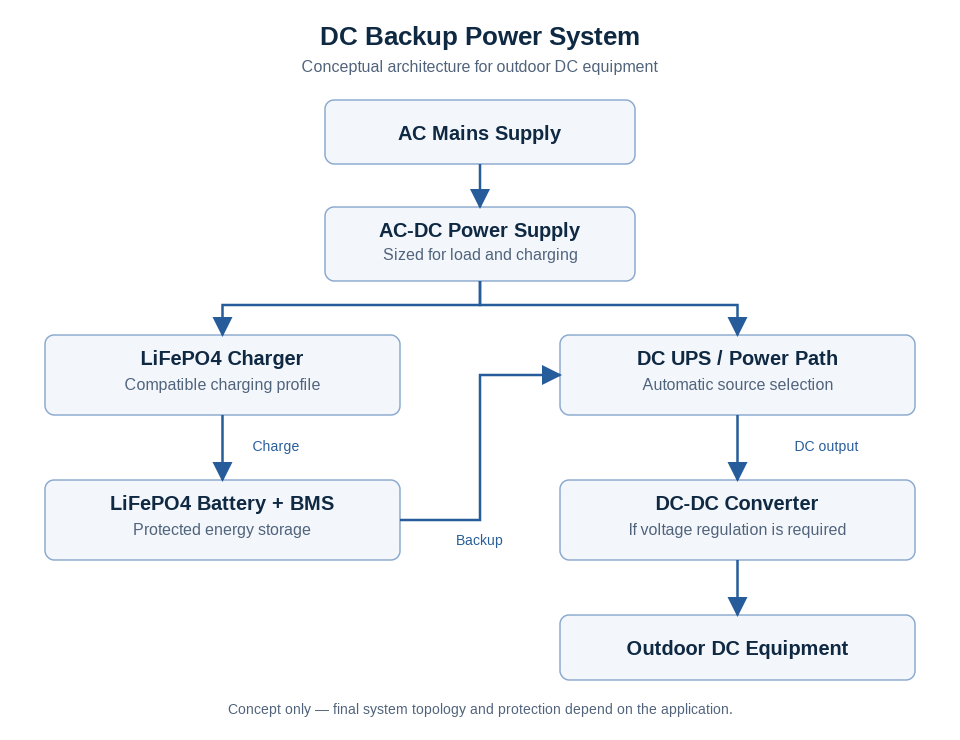
DC Backup Power Systems
For equipment operating directly on DC power, a battery system may be combined with a compatible charger, backup switching module and regulated DC-DC converter.
A typical configuration includes:
- LiFePO4 battery pack with BMS.
- Compatible battery charging unit.
- Automatic backup power switching module.
- Regulated DC-DC converter, where required.
- Electrical protection and output connections.
A DC-based architecture can avoid unnecessary DC-to-AC conversion and may improve overall system efficiency.
However, the equipment's allowable input voltage range must be confirmed. A nominal 12.8V lithium battery does not necessarily provide the regulated 12V output required by sensitive electronic equipment.
AC Backup Power Systems
For equipment requiring AC input, the battery may need to operate with a compatible inverter or UPS system.
In this configuration, inverter efficiency, surge power, standby consumption, output waveform and transfer time must be considered during battery selection.
| System Type | Typical Applications | Key Design Considerations |
|---|---|---|
| DC backup power | Access control, monitoring and communication devices | Voltage regulation and switching |
| AC backup power | AC lighting, industrial terminals and AC-powered equipment | Inverter compatibility and transfer time |
| Hybrid AC/DC backup | Equipment with multiple power requirements | Output coordination and system integration |
There is no single architecture suitable for every outdoor application. The most appropriate solution depends on the equipment and its operating requirements.
4. Determine Whether Automatic Power Switching Is Required
A standalone battery does not automatically function as an uninterruptible power supply.
For equipment that must continue operating during a mains power failure, the system requires a suitable power switching or UPS architecture.
Under normal conditions, the primary power source supplies the equipment while the battery is maintained by a compatible charging system.
When the primary power source fails, the backup system supplies the load using battery power.
After power is restored, the system returns to its normal operating mode and recharges the battery.
The allowable transfer time depends on the connected equipment. Some electronic devices may restart or temporarily lose communication even during a short interruption.
For these applications, switching performance must be confirmed under actual operating conditions.
5. Select a Compatible BMS and Charging System
The battery management system plays an important role in protecting the lithium battery pack.
Depending on the battery configuration, relevant BMS functions may include:
- Overcharge and over-discharge protection.
- Overcurrent and short-circuit protection.
- Temperature monitoring and protection.
- Cell balancing.
- Battery monitoring and communication, where supported.
The BMS discharge rating must accommodate both normal operating current and short-duration peak loads. Cell capability, wiring, connectors and thermal conditions must also support the required current. External circuit protection should be selected for the complete system; a BMS does not replace all necessary external protection.
The charging system must match the battery chemistry, voltage range and permitted charging current.
For outdoor backup applications, it is also important to determine how the battery will be recharged while the equipment continues operating. The power supply must accommodate the operating load and charging demand, or the controller must appropriately limit charging current.
Low-temperature charging protection should be considered where the installation environment may fall below the battery manufacturer's permitted charging temperature.
6. Consider Outdoor Environmental Protection
Outdoor installations introduce environmental challenges that are different from indoor battery applications.
The complete backup power system may need to withstand:
- Rain, dust and moisture.
- High and low ambient temperatures.
- Direct sunlight and heat accumulation.
- Condensation.
- Corrosive or coastal environments.
- Mechanical vibration and installation constraints.
Enclosure protection ratings, such as IP65 or IP67, should be selected according to the actual installation environment and verified for the final assembled system.
An IP rating defines protection against ingress under specified test conditions. It does not independently establish corrosion resistance, UV resistance, thermal performance or long-term outdoor durability.
IP67 immersion protection does not automatically establish compliance with IP65 water-jet protection requirements.
Enclosure design must also consider cable entry points, connectors, sealing, heat dissipation and maintenance accessibility.
A suitable battery enclosure is therefore only one part of the complete outdoor protection strategy.
7. Choose a Standard Battery or a Customized Power Solution
For some applications, an existing LiFePO4 battery model combined with compatible power components can meet the equipment's requirements.
Using an established battery configuration may reduce development time, engineering costs and additional validation requirements.
However, customized battery and power solutions may be necessary when the project requires:
- Specific installation dimensions.
- Extended backup duration.
- Multiple regulated output voltages.
- Automatic backup power switching.
- Application-specific charging requirements.
- Customized electrical interfaces.
- Special enclosure or mounting arrangements.
The objective is not necessarily to develop a completely new battery. It is to identify the most practical configuration that meets the equipment's electrical, mechanical and environmental requirements.
At ASOL Battery, we evaluate existing battery models first and consider customized configurations when standard products do not meet the application requirements.
8. What Should Buyers Confirm Before Requesting a Quotation?
Providing clear application information allows battery manufacturers to evaluate a more suitable backup power configuration.
| Requirement | Information to Provide |
|---|---|
| Application | Equipment type and operating environment |
| Output voltage | Required AC or DC voltage |
| Power consumption | Average load, maximum load and start-up demand |
| Backup duration | Required operating time during a power outage |
| Power switching | Maximum acceptable interruption time |
| Charging source | Mains power, solar or other available sources |
| Recharge requirement | Required time to restore battery capacity |
| Installation | Available dimensions and mounting method |
| Environmental protection | Temperature, IP rating and corrosion requirements |
| Project requirements | Estimated quantity and applicable compliance requirements |
Equipment specifications, electrical diagrams and photographs of the installation environment can also support the engineering evaluation.
These details help reduce unnecessary design changes and improve compatibility between the battery system and the equipment.
9. Lithium Battery and Power Integration Solutions from ASOL
ASOL Battery manufactures and supplies LiFePO4 batteries, lithium battery packs and OEM/ODM battery solutions for equipment manufacturers, distributors and industrial projects.
For outdoor equipment requiring backup power, we can evaluate battery configurations together with compatible charging units, inverters, DC-DC converters, automatic backup switching modules and protective enclosures.
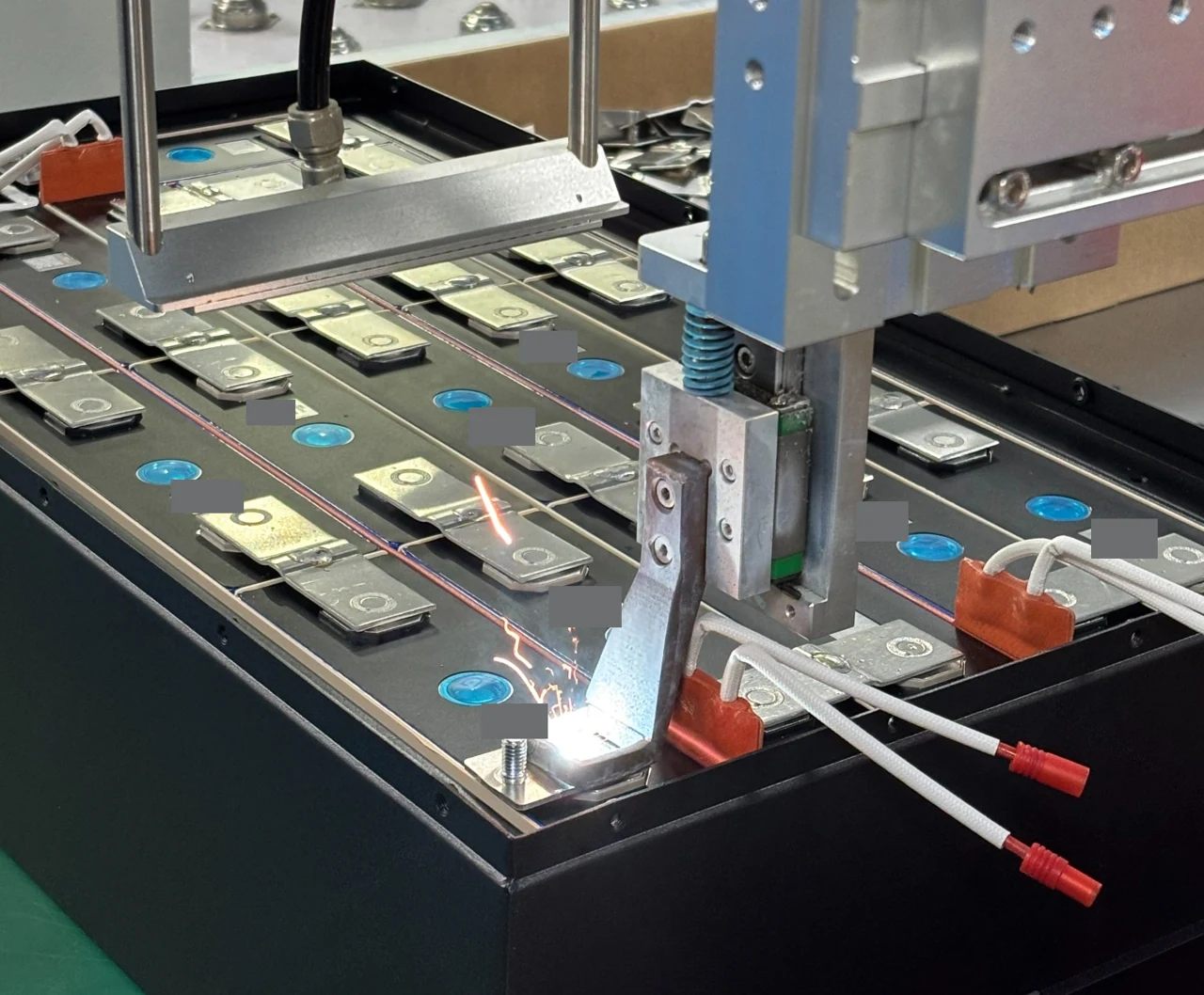
Our approach considers equipment load, required backup duration, electrical compatibility and installation conditions.
Whether an application requires a standard LiFePO4 battery or an application-specific power solution, the configuration is evaluated according to the actual project requirements.
Learn more about our Custom Lithium Battery Pack Manufacturing & OEM/ODM Solutions and Energy Storage & Outdoor Equipment Battery Solutions.
Frequently Asked Questions
Can a LiFePO4 battery directly power 12V outdoor equipment?
It depends on the equipment's permitted input voltage range. Some devices can accept the operating voltage range of a nominal 12.8V LiFePO4 battery, while others require a regulated 12V output through a compatible DC-DC converter.
Can a standard lithium battery be used as a UPS?
A standalone lithium battery provides energy storage but does not independently provide automatic power switching. A compatible UPS or backup switching system is required where uninterrupted equipment operation is necessary. The permissible interruption time must be verified for the connected load.
How long can a 12.8V 100Ah LiFePO4 battery power outdoor equipment?
The nominal battery energy is 1,280Wh. For a constant 60W load, assuming 90% overall efficiency and 80% usable battery capacity, the preliminary estimated runtime is approximately 15.4 hours.
Actual runtime depends on equipment load, temperature, battery condition and system configuration.
Is IP65 sufficient for outdoor battery installations?
IP65 may be suitable for certain outdoor installations, but suitability depends on the actual exposure conditions. Corrosion, condensation, sunlight, temperature and the protection of the complete assembled system must also be evaluated.
Conclusion
A reliable outdoor backup power system requires more than selecting a battery with sufficient nominal capacity.
Battery sizing, voltage compatibility, automatic power switching, charging, environmental protection and system integration should be evaluated together.
By defining these requirements early, equipment manufacturers and system integrators can identify a more practical backup power solution while reducing development risks and unnecessary procurement costs.
If you are developing an outdoor equipment backup power project, contact ASOL Battery to discuss your equipment requirements and suitable battery configurations.